Well Volume Calculator
Enter the casing diameter, well depth and depth to water to get the gallons in the well, the purge volume and an optional shock chlorination dose.
How to use the Well volume calculator
- Click one of the preset buttons above the form to load a typical case, or keep the starting example.
- Enter the casing inside diameter, then choose in, mm or cm from its unit menu.
- Enter the total depth and the depth to water, both measured from the top of the casing. Choose ft or m for each from its unit menu.
- Read the water column, then the volume in US gallons and litres, plus gallons per foot and litres per metre of casing.
- Open More options to set the number of well volumes for purging. The default is 3, and the purge volume appears in the results.
- If you want a disinfection dose, tick Also calculate shock chlorination (bleach), then choose the chlorine target and the product, and enter the other water in the system (tank, heater, pipes). Check the warnings shown next to any value outside the allowed range.
- Open How it was calculated under the result to see the formula, the values used and the answer with units.
Use Reset to return to the starting example at any time. Copy result, Copy link and Print / save as PDF are covered in the FAQ below.
How much water is in my well?
The water in a well is the column of water standing above the bottom of the well, multiplied by the cross-section area of the casing. Volume equals π/4 × D² × water column, where D is the casing inside diameter.
How is well volume calculated?
The water column is the total well depth minus the depth to the static water level, both measured from the top of the casing. The area comes from the inside diameter, and the result is then converted to gallons and litres. One cubic foot is 7.4805 US gallons (231 cubic inches per gallon), which the guides round to 7.48.
For a 6 in casing, the area gives 1.469 gallons per foot. That matches the 1.47 gal/ft in University of Georgia Extension and Montana county guides. The computed values for 4, 5, 6, 7, 8, 10, 12, 20, 24 and 36 in casing agree with the Georgia table within 0.5%.
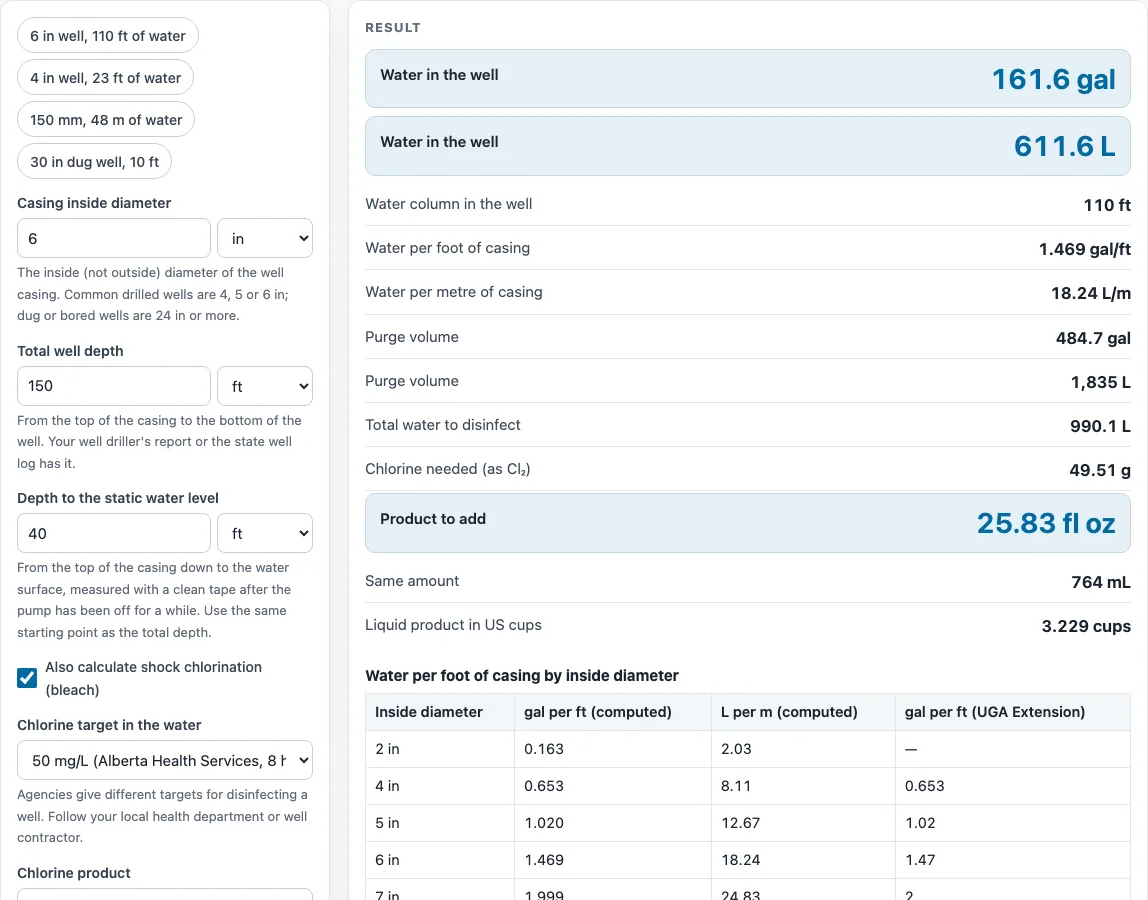
Worked example: a 6 in casing is 150 ft deep, and the water is at 40 ft. The water column is 110 ft, which holds 161.6 US gallons (611.6 L). Three well volumes is 484.7 gallons.
How much chlorine does a well need for shock chlorination?
The chlorine needed in grams equals the target in mg/L times the litres of water to disinfect, divided by 1,000. Then divide that by the strength of your product to get the amount of product. The water to disinfect is the well plus any other water you enter, such as a pressure tank, water heater or plumbing. The University of Nevada Extension adds 3 gallons per toilet and 10 gallons for plumbing.
Agencies publish different targets, so they are listed here by source (checked 12 October 2026). The calculator shows the same table under the result.
| Source | Target | Contact time |
|---|---|---|
| California State Water Board, Division of Drinking Water, well disinfection procedure (follows AWWA C654-13) | 50 mg/L | — |
| Alberta Health Services, shock chlorination of contaminated wells | 50 mg/L | at least 8 h |
| Ohio Adm. Code 3745-9-08, well disinfection (effective 1 Sep 2022) | at least 100 mg/L at the start (or hold at least 50 mg/L throughout) | at least 8 h |
| Stillwater County, Montana, how to shock your private well | 200 mg/L throughout the system | — |
| University of Nevada Cooperative Extension FS-06-69, estimating the amount of bleach needed | 250 mg/L | at least 12 h |
The default target is 50 mg/L. It is the figure in the California State Water Board procedure, which follows the national well-disinfection standard AWWA C654-13, and Alberta Health Services uses the same number. It is also the smallest of the listed doses, so there is the least chlorine to flush out afterwards. If your local agency publishes its own number, such as Ohio’s 100 mg/L, pick it or enter it as Other target.
Worked example: the well above plus 100 gallons of other water is 990 L, and a 50 mg/L target needs 49.5 g of chlorine. That is 25.8 fl oz (764 mL) of 6% bleach. As a cross-check, 100 gallons at 250 ppm needs about 7 cups of bleach, which matches the Nevada table.
How many gallons should I purge before sampling?
The purge volume is the number of well volumes you set multiplied by the well volume. The default is 3, which is the default minimum in the Nebraska DEE groundwater sampling SOP GW-060 (July 2024). That SOP notes that other methods, such as low-flow sampling, can be acceptable.
Sources
Checked October 2026:
- Gallons per foot of casing (comparison table): University of Georgia Extension, Disinfecting your well water: shock chlorination (C858-4); Stillwater County, Montana, how to shock your private well (200 mg/L)
- Shock chlorination targets: the five sources in the table above (California State Water Board, Alberta Health Services, Ohio Adm. Code 3745-9-08, Stillwater County, University of Nevada Extension); 3 gal per toilet and 10 gal plumbing: University of Nevada Extension FS-06-69
- Three well volumes before sampling: Nebraska DEE SOP GW-060
- 1 US gal = 231 in³ (NIST); bleach strengths as on the chlorine dosage calculator
For estimation; verify critical designs against the applicable standard.
Worked examples
| Input | Result |
|---|---|
| 6 in casing, 110 ft of water | 161.6 gal (611.6 L) in the well, 50 mg/L needs 25.8 fl oz of the product |
| 4 in casing, 23 ft of water | 15.01 gal (56.84 L) in the well, 250 mg/L needs 42.5 fl oz of the product |
| 150 mm casing, 48 m of water | 224.1 gal (848.2 L) in the well, 200 mg/L needs 1.84 L of the product |
| 30 in casing, 10 ft of water | 367.2 gal (1,390 L) in the well |
Calculated by the tool above with these values.
Frequently asked questions
Can I use the results in commercial projects or client reports?
Yes. You can use the results in commercial work, including quotes, design notes, reports and client projects, without attribution. The page also notes under each result: “For estimation; verify critical designs against the applicable standard.”
Is the calculator free, and is anything I type uploaded?
Yes, the calculator is free. Everything is calculated in your browser, so nothing you type is uploaded. There is no account or sign-up.
Can I print or share a calculation?
Yes. Print / save as PDF prints a one-page record with your inputs, results, calculation steps and the date. Copy link copies the page address, which stores every input in the ?s= part of the URL, so the same calculation reopens later or can be sent to a colleague. Copy result copies the result lines with a link.
How many gallons per foot is a 4 in or 6 in well?
A 6 in casing holds about 1.47 gallons per foot of water, and a 4 in casing about 0.65 gallons per foot. The calculator works these out from the inside diameter you enter, so use the real inside diameter of your casing.
Does the calculator confirm that my well water is safe?
No. The calculator does not say a well is safe or disinfected. Retest the water after chlorinating, and follow your local health department’s guidance.
Related tools
- Chlorine dosage calculator: use it to work out chlorine doses for pools, tanks and other water when the well is not the only source.
- Tank size calculator: use it to check the storage tank capacity for your water supply.
- Water usage calculator: use it to estimate how much water your household or site uses each day.
- Water softener size calculator: use it to size a softener for your water hardness and daily use.
- TDS calculator: use it to convert or check total dissolved solids in your water.
- All water treatment calculators: use it to browse every calculator on the site.