Water Softener Size Calculator
Enter the people in the home and your water hardness to get the grains removed per day and the smallest common softener size that covers them.
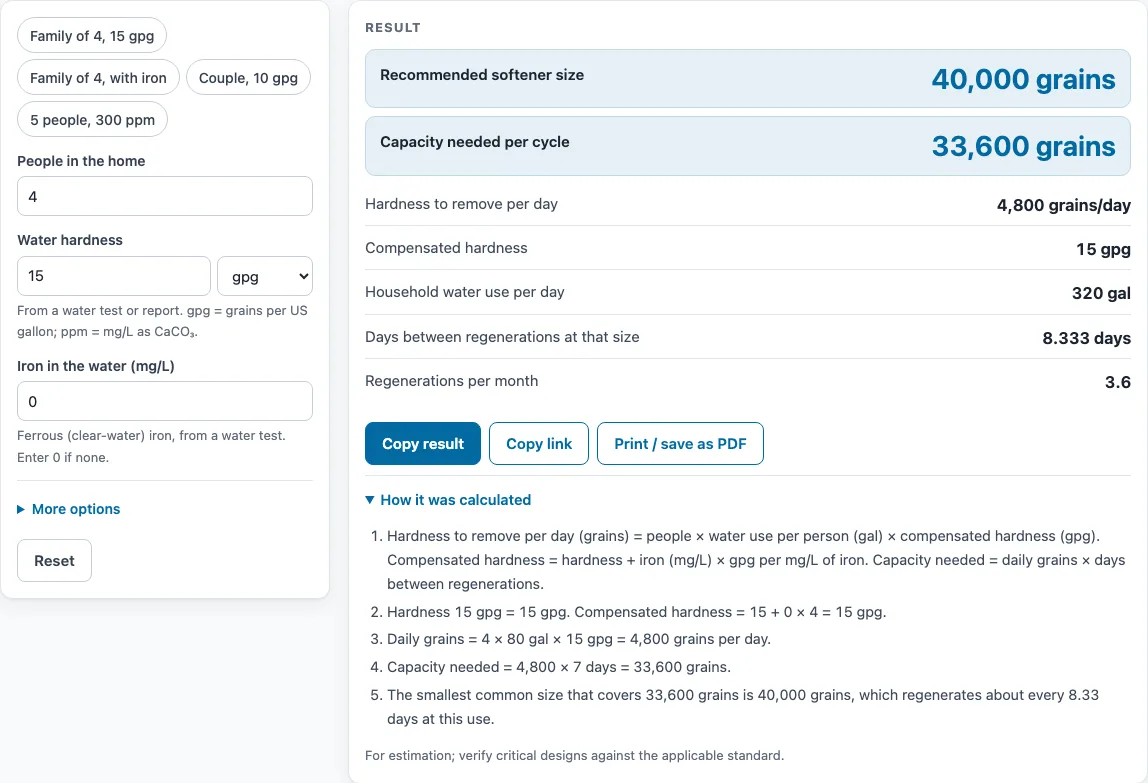
How to use the Water Softener Size Calculator
- Start with a preset if one is close to your home. The preset buttons above the form load family of 4 at 15 gpg, family of 4 with 2 mg/L iron, couple at 10 gpg, or 5 people at 300 ppm.
- Enter the number of people in your home. The default is 4.
- Enter your water hardness and choose its unit from the menu: gpg, ppm, °dH or °fH. The default is 15 gpg.
- Enter iron in mg/L if your water contains it. The default is 0.
- Open More options to change water use per person per day (default 80 gal), days between regenerations (default 7) and the iron factor (default 4).
- Read the result: recommended softener size, capacity needed per cycle, hardness to remove per day, compensated hardness, household water use per day, days between regenerations at the recommended size, and regenerations per month.
- Read any warning below the result, such as hardness under 1 gpg, iron above 5 mg/L, or a capacity above 110,000 grains.
- Open How it was calculated under the result to see the formula, the values substituted and the answer with units.
Reset restores the example, Copy link keeps every input in the page address, and Print / save as PDF gives a dated record.
How do you determine water softener size?
Multiply the number of people, the water each person uses per day, and the compensated hardness to get the grains of hardness removed each day. Multiply that by the days between regenerations to get the capacity needed per cycle, then choose the smallest common size at or above that figure.
Daily grains = people × water use per person per day (gal) × compensated hardness (gpg). Capacity needed = daily grains × days between regenerations. For a family of 4 using 80 gal each at 15 gpg, that is 4 × 80 × 15 = 4,800 grains per day, or 33,600 grains over a 7-day cycle. The smallest common size that covers 33,600 is 40,000 grains.
What does compensated hardness mean?
Compensated hardness is the hardness in your water plus an allowance for iron. Iron also uses up softener capacity, so the calculator adds it to the hardness. The allowance is iron in mg/L multiplied by the iron factor, and the factor is usually taken as 3 to 5 gpg per mg/L of ferrous iron. The default is 4. Treat this as a rule of thumb, not a measured value.
Why does the calculator use 80 gallons per person per day?
The default of 80 gal per person per day is close to the US EPA WaterSense figure of about 82 gal per person per day at home. You can change the figure in More options if you know your household’s actual use.
What is a water softener grains calculator measuring?
It measures hardness in grains, where 1 gpg (grain per US gallon) equals 17.118 mg/L as CaCO₃. Hardness given in ppm, °dH or °fH is converted to gpg using this value. For example, 300 ppm equals 17.53 gpg. Working in grains makes it easy to compare the water’s hardness load with the capacity of each softener size.
Sources
Checked October 2026:
- EPA WaterSense, statistics and facts: 82 gallons per person per day at home (USGS 2015 data)
- Hardness unit definitions as in the hardness converter
- The iron allowance and the list of softener sizes are common practice, not a standard: follow the sizing guide of the softener you buy
For estimation; verify critical designs against the applicable standard.
Worked examples
| Input | Result |
|---|---|
| 4 people, 15 gpg, 0 mg/L iron | 4,800 grains/day, 33,600 grains per cycle: a 40,000 grain softener |
| 4 people, 15 gpg, 2 mg/L iron | 7,360 grains/day, 51,520 grains per cycle: a 64,000 grain softener |
| 2 people, 10 gpg, 0 mg/L iron | 1,500 grains/day, 10,500 grains per cycle: a 16,000 grain softener |
| 5 people, 300 ppm, 0 mg/L iron | 6,945 grains/day, 48,610 grains per cycle: a 64,000 grain softener |
| 8 people, 30 gpg, 0 mg/L iron | 24,000 grains/day, 168,000 grains per cycle: a 110,000 grain softener |
Calculated by the tool above with these values.
Frequently asked questions
Can I use the results in commercial projects or client reports?
Yes. You can use results in commercial work, including quotes, design notes, reports and client projects, without attribution. Under the result the page also says: “For estimation; verify critical designs against the applicable standard.”
Is the calculator free, and is anything I type uploaded?
The calculator is free, and there is no account or sign-up. Everything is calculated in your browser, and nothing you type is uploaded.
Can I print or share a calculation?
Yes. Print / save as PDF produces a one-page record with the inputs, results, calculation steps and date. Copy link copies the page address, which stores every input, so the same calculation reopens for you later or for a colleague.
Does the calculator tell me how much salt to use?
No. Salt use per regeneration depends on the softener model and its salt dose setting, so the calculator does not show it. Check the manufacturer’s specifications for that figure.
Why does a warning appear for iron above 5 mg/L?
A softener can take up some ferrous iron, which is why iron is added to the hardness, but at high levels a softener alone is usually not the right treatment. Have the water tested and check the treatment with a water-treatment specialist before you rely on the size shown.
Related tools
- Septic Tank Size Calculator: use it when you are sizing a septic tank for household wastewater.
- Water Hardness Chart and Converter: use it to convert hardness between gpg, ppm, °dH and °fH before you enter it here.
- Water Usage Calculator: use it to estimate your household’s daily water use, which feeds the per-person figure.
- Tank Size Calculator: use it to work out the volume of a tank of any shape.
- Aquarium Volume Calculator: use it to find how much water an aquarium holds.
- Chlorine Dosage Calculator: use it to estimate how much chlorine to add to a volume of water.
- Langelier Saturation Index Calculator (LSI): use it to check whether water tends to scale or corrode pipes.
- All water treatment calculators: use it to browse every water treatment calculator on the site.