Water Hardness Chart and Converter
Enter a hardness in any unit to see it in all the others and its hardness class, or work it out from calcium and magnesium results.
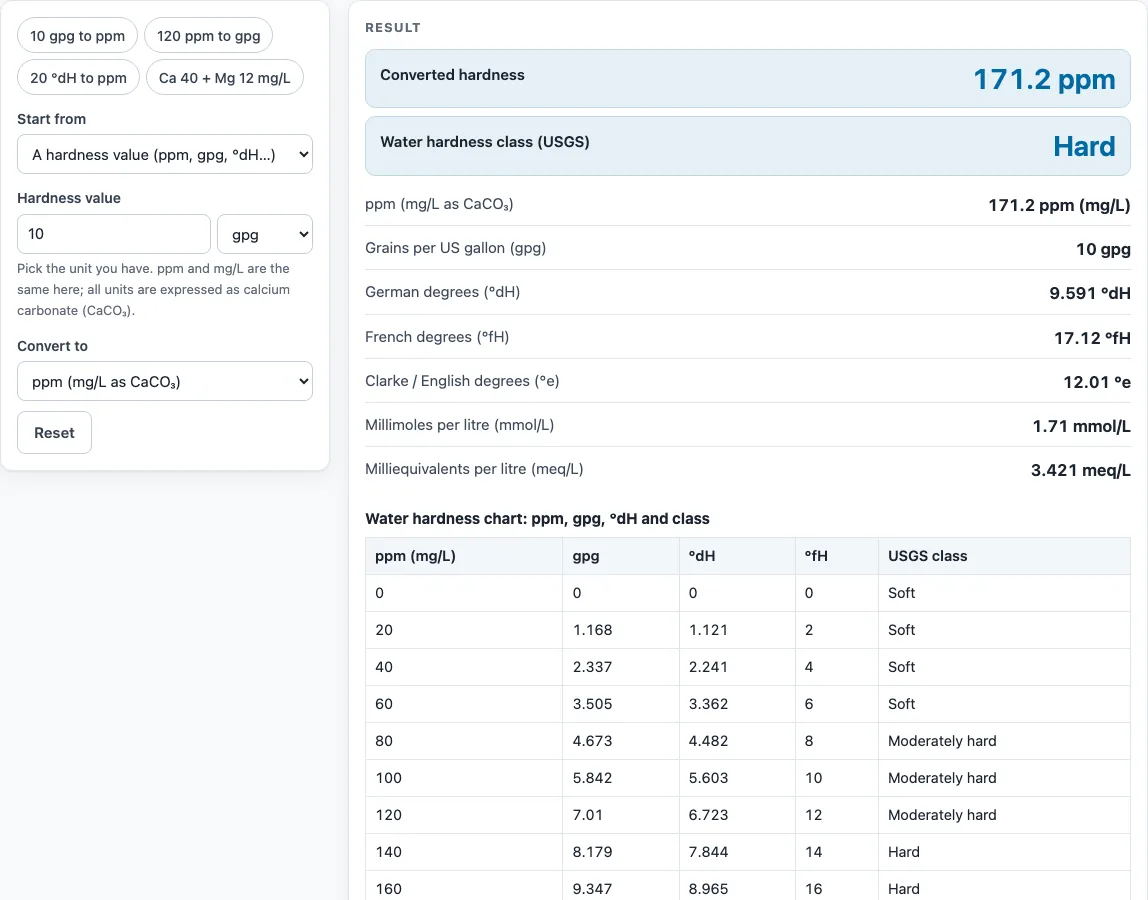
How to use the water hardness converter
- Under Start from, choose “A hardness value” to convert one reading, or “Calcium and magnesium” to calculate total hardness from the two ions.
- Enter the value and pick its unit from the unit menu. In calcium and magnesium mode, enter Ca and Mg in mg/L. At least one must be above zero.
- Pick the unit to convert to. Each quantity has its own unit menu, so metric and US customary units can be mixed.
- Read the converted value, the USGS hardness class and the value in all seven units. The result updates as you type.
- Open “How it was calculated” under the result to see the formula, the values substituted and the answer with units.
- Scroll down to the water hardness chart: 0 to 400 ppm in 15 rows, each with gpg, °dH and the hardness class.
- Use Copy result to copy the result lines with a link, Copy link to keep every input in the page address, or Print / save as PDF for a dated one-page record of the conversion.
The default is 10 gpg to ppm. Preset buttons above the form load typical cases: 10 gpg to ppm, 120 ppm to gpg, 20 °dH to ppm, and calcium 40 plus magnesium 12 mg/L. Less common inputs sit under “More options,” and “Reset” restores the starting example.
How do you read a water hardness chart (ppm water hardness chart)?
Each row of the chart under the result is one hardness level in ppm as CaCO₃ with the same water in gpg and °dH and its USGS class. The class boundaries are the useful landmarks: 60 ppm is 3.505 gpg or 3.36 °dH (top of soft), 120 ppm is 7.010 gpg or 6.72 °dH (top of moderately hard) and 180 ppm is 10.52 gpg or 10.09 °dH (top of hard). Softener makers usually quote hardness in gpg, while lab reports and utilities usually give ppm or mg/L, so the gpg to ppm and ppm to gpg columns are the ones most people need.
How is one hardness unit converted into another?
The converter multiplies the input by its unit’s factor to reach ppm, then divides by the target unit’s factor. Every unit is measured against the same basis: milligrams per litre as CaCO₃, which is the same as ppm. The factors are 1 gpg = 17.118, 1 °dH = 17.848, 1 °fH = 10, 1 °e = 14.254, 1 mmol/L = 100.09 and 1 meq/L = 50.04 mg/L as CaCO₃.
For the default example, 10 gpg × 17.118 = 171.18, shown as 171.2 ppm. Dividing that by the °dH factor gives 9.591 °dH. The page shows each of these steps under the result.
For calcium and magnesium, the total hardness as CaCO₃ uses the Standard Methods 2340 B relation: 2.497 × Ca + 4.118 × Mg, with Ca and Mg in mg/L as the ions. For calcium 40 mg/L and magnesium 12 mg/L, that is 99.88 + 49.42 = 149.3 ppm, which is 8.722 gpg.
Degree definitions differ by country. The factors here are the common ones based on CaCO₃, so a °dH figure from another source may not match exactly. Always check which definition a source uses before comparing numbers.
Sources
Checked October 2026:
- USGS, Hardness of water: soft 0 to 60, moderately hard 61 to 120, hard 121 to 180, very hard above 180 mg/L as CaCO₃
- Standard Methods for the Examination of Water and Wastewater, method 2340 B: hardness = 2.497 Ca + 4.118 Mg
- Unit definitions: 1 gpg = 64.79891 mg per 3.785411784 L = 17.118 mg/L; 1 °dH = 10 mg CaO/L = 17.848 mg/L CaCO₃; 1 °fH = 10 mg/L CaCO₃; 1 mmol/L = 100.09 mg/L CaCO₃
For estimation; verify critical designs against the applicable standard.
Worked examples
| Input | Result |
|---|---|
| 10 gpg | 171.2 ppm, Hard |
| 120 ppm | 7.01 gpg, Moderately hard |
| 20 °dH | 357 ppm, Very hard |
| 2.5 mmol/L | 14.02 °dH, Very hard |
| Ca 40 mg/L, Mg 12 mg/L | 8.722 gpg, Hard |
Calculated by the tool above with these values.
Frequently asked questions
Can I use the results in commercial projects or client reports?
Yes. Results may be used in commercial work, including quotes, reports and client projects, without attribution.
Is the calculator free, and is anything I type uploaded?
Yes, the calculator is free and needs no account or sign-up. Everything is calculated in your browser, and nothing you type is uploaded.
Can I print or share a calculation?
Yes. “Print / save as PDF” produces a one-page record with the inputs, results, calculation steps and date. “Copy link” copies the page address, which stores every input in the ?s= part of the URL, so the same calculation reopens later or can be sent to a colleague.
What do the USGS hardness classes mean?
Using mg/L as CaCO₃, 0 to 60 is soft, 61 to 120 is moderately hard, 121 to 180 is hard and above 180 is very hard. The converter shows the class with each result. For example, 120 ppm sits at the upper edge of moderately hard.
Why do my °dH or °fH values differ from another chart?
Degree definitions differ by country, and this converter uses common CaCO₃-based factors: 1 °dH = 17.848 ppm, 1 °fH = 10 ppm and 1 °e = 14.254 ppm. A chart using a different basis will give different numbers for the same water.
What happens with negative values or very high readings?
Negative values give an error, because hardness cannot be below zero. A value above 2,000 ppm gives a warning that it is far beyond normal drinking water.
Related tools
- Water Softener Size Calculator: use it to size a softener once you know your water’s hardness.
- Water Usage Calculator: use it to estimate how much water your household or site uses.
- Chlorine Dosage Calculator: use it to estimate chlorine doses for treated water.
- Langelier Saturation Index Calculator (LSI): use it to check whether water tends to scale or corrode, using hardness among other inputs.
- Pool Chlorine Calculator: use it to work out chlorine amounts for a pool.
- Aquarium Volume Calculator: use it to find the water volume of an aquarium before dosing or treating it.
- All water treatment calculators: use it to browse every calculator on the site.