TDS Calculator (Total Dissolved Solids)
Calculate total dissolved solids from a conductivity reading or a water analysis, and compare the result with the 500 mg/L drinking water guideline.
The TDS calculator estimates total dissolved solids in water, reported in mg/L (the same as ppm), from an electrical conductivity (EC) reading or from a list of dissolved ions. It has three modes: TDS from EC, EC from a TDS value, and TDS from the sum of ions. Every result is compared with the EPA secondary standard of 500 mg/L and is also shown in grains per gallon.
The calculator runs in your browser. It is free, and there is no account or sign-up. TDS here means total dissolved solids in water, not a tax term. Use it to check a meter reading, make a water-quality estimate or convert between EC and TDS for a report.
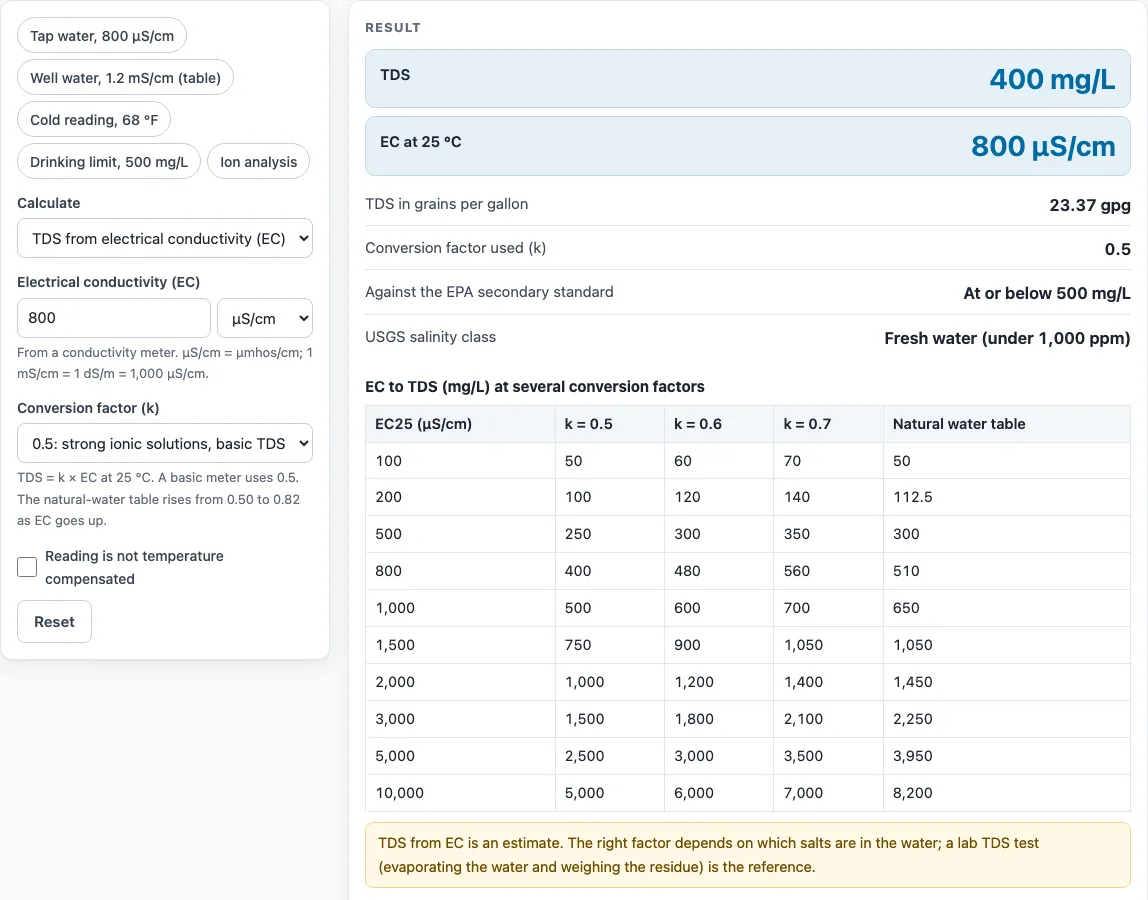
How to use the TDS calculator
- Under “Calculate”, pick TDS from electrical conductivity (EC), EC from a TDS value, or TDS from the sum of ions.
- In EC mode, type the EC value and choose its unit from the unit menu: µS/cm, mS/cm, dS/m or µmhos/cm. Each quantity has its own unit menu, so you can mix metric and US units.
- Choose the factor k: 0.5, 0.7, the natural-water table or a custom factor. If you are unsure which salts are present, start with 0.5, the fixed factor of basic meters.
- If the reading is not temperature-compensated, tick the box, enter the water temperature and choose α: 1.91%, 2% or 2.12% per °C, or type your own value.
- In sum-of-ions mode, enter Ca, Mg, Na, K, SO4, Cl, NO3, SiO2, carbonate, other solids and HCO3. Check the ion balance (cations against anions in meq/L) to catch typing errors.
- Read the result. It updates as you type. Check the comparison with 500 mg/L and the grains per gallon value, then open “How it was calculated” to see the formula, the substituted values and the answer with units.
Preset buttons load typical cases, and Reset restores the starting example. Copy result copies the result lines with a link. Copy link copies the page address, which stores every input in the ?s= part of the URL, so the same calculation reopens later or can be sent to a colleague. Print / save as PDF prints a one-page record with the inputs, results, calculation steps and date.
How do you calculate total dissolved solids from electrical conductivity?
You calculate total dissolved solids from EC with one multiplication: TDS = k × EC, where EC is measured at 25 °C. Dissolved salts carry electric current, so conductivity rises with their concentration, and the factor k converts that reading into an estimated mass of dissolved solids in mg/L.
The factor k depends on the salts in the water. Strong ionic solutions use 0.5, and weak ionic solutions such as fertilizer use 0.7. For natural water, the calculator uses the NDSU Extension table (WQ1923, revised January 2024). In that table k rises from 0.50 at 100 µS/cm to 0.65 at 1,000 µS/cm, 0.75 at 3,000 µS/cm and 0.82 at 10,000 µS/cm, and the calculator interpolates between these rows. Outside 100 to 10,000 µS/cm it holds the end values and shows a warning.
Conductivity also changes with temperature, so a reading taken at another temperature must be corrected first: EC25 = EC ÷ (1 + α(t − 25)). For environmental waters, α is about 2% per °C. Meters built on KCl use 1.91%, and meters built on NaCl use 2.12%. Units follow 1 mS/cm = 1 dS/m = 1,000 µS/cm. For example, 800 µS/cm at k = 0.5 gives 400 mg/L, or 23.4 gpg.
In sum-of-ions mode, TDS is the sum of Ca, Mg, Na, K, SO4, Cl, NO3, SiO2, carbonate and other solids, plus 0.4917 × HCO3. Bicarbonate turns into carbonate when water is evaporated, which is why its weight is adjusted (USGS Water-Quality Information Note 2005.05).
The formula also runs in reverse. EC25 = TDS ÷ k, so 500 mg/L at k = 0.5 gives 1,000 µS/cm. The true reference value is a lab test that evaporates a sample and weighs the residue. The calculator does not include NaCl, 442 or KCl conversion factors, because published values differ between meter makers.
Sources
Checked October 2026:
- k factors 0.5 and 0.7 by solution type: Hanna Instruments, EC and TDS
- Natural-water k table (0.50–0.82 by EC): NDSU Extension, Using Electrical Conductivity (WQ1923)
- Temperature coefficients 1.91 %, 2 %, 2.12 % per °C: USGS WaQI 2006.01; bicarbonate × 0.4917 in the sum of ions: USGS WaQI 2005.05
- 500 mg/L secondary standard: US EPA; salinity classes: USGS Water Science School; molar masses for the ion balance: IUPAC CIAAW
For estimation; verify critical designs against the applicable standard.
Worked examples
| Input | Result |
|---|---|
| EC 800 µS/cm, factor 0.5 | TDS 400 mg/L (23.4 gpg) |
| EC 1.2 mS/cm, factor 0.675 | TDS 810 mg/L (47.3 gpg) |
| EC 950 µS/cm, factor 0.7 | TDS 738.9 mg/L (43.2 gpg) |
| TDS 500 mg/L, factor 0.5 | EC25 1,000 µS/cm |
| Ca, Mg, Na, K, HCO₃, SO₄, Cl, NO₃, SiO₂ entered | TDS 293.2 mg/L (17.1 gpg) |
Calculated by the tool above with these values.
Frequently asked questions
What is a good TDS level for drinking water?
The EPA secondary standard for TDS is 500 mg/L. It is set for taste, hardness, deposits and staining rather than health, and the calculator compares every result with it. Above that level, water may taste salty or leave deposits and colored stains.
Should I use 0.5 or 0.7 for the TDS conversion factor?
Use 0.5 for strong ionic solutions, the fixed factor of many basic meters. Use 0.7 for weak ionic solutions such as fertilizer. For natural water, the natural-water table is designed for that purpose and is the better choice.
Can I use the results in commercial projects or client reports?
Yes. Results may be used in commercial work, including quotes, design notes, reports and client projects, without attribution.
Is the calculator free, and is anything I type uploaded?
Yes, it is free. Every calculation runs in your browser, nothing you type is uploaded, and no account or sign-up is needed.
Can I print or share a calculation?
Yes. Print / save as PDF produces a one-page record with the inputs, results, calculation steps and date. Copy link copies a page address that stores every input, so the same calculation reopens later or can be sent to a colleague.
Does TDS in this calculator have anything to do with tax?
No. Here, TDS means total dissolved solids in water, measured in mg/L (the same as ppm). It has no connection to tax.
How accurate is a TDS value calculated from EC?
It is an estimate. The right factor depends on which salts are in the water, and the true reference is a lab test that evaporates the sample and weighs the residue. Use the result for screening or planning, and confirm critical values with a lab.
Related tools
- Water hardness chart: use it to compare hardness with TDS when judging scale and softening needs.
- Salinity calculator: use it when your water is saline and you need salinity figures rather than TDS alone.
- Water softener size calculator: use it to size a softener once you know the hardness and water use.
- Langelier saturation index calculator: use it to check whether water is likely to scale or corrode pipes.
- Chlorine dosage calculator: use it to work out how much chlorine a water volume needs.
- All water treatment calculators: use it to browse every calculator on the site.