Septic Tank Size Calculator
Enter the number of bedrooms or the daily flow to get the septic tank size in gallons and litres, with a chart for 1 to 8 bedrooms.
How to use the Septic Tank Size Calculator
- Under Size the tank from, choose Number of bedrooms for a house, or Daily flow for a commercial building or other use.
- For a house, enter the number of bedrooms as a whole number. Otherwise enter the design flow in gal per day or litres per day.
- Set the unit for each quantity using its unit menu. You can mix metric and US customary units, and the calculator converts them before it calculates.
- Check the retention time. It defaults to 2 days.
- Open More options only if your local code uses different values. There you can change the flow per bedroom (default 150 gal per bedroom per day), the retention time, or the minimum tank size (default 1,000 US gal, editable in gal, L or m³).
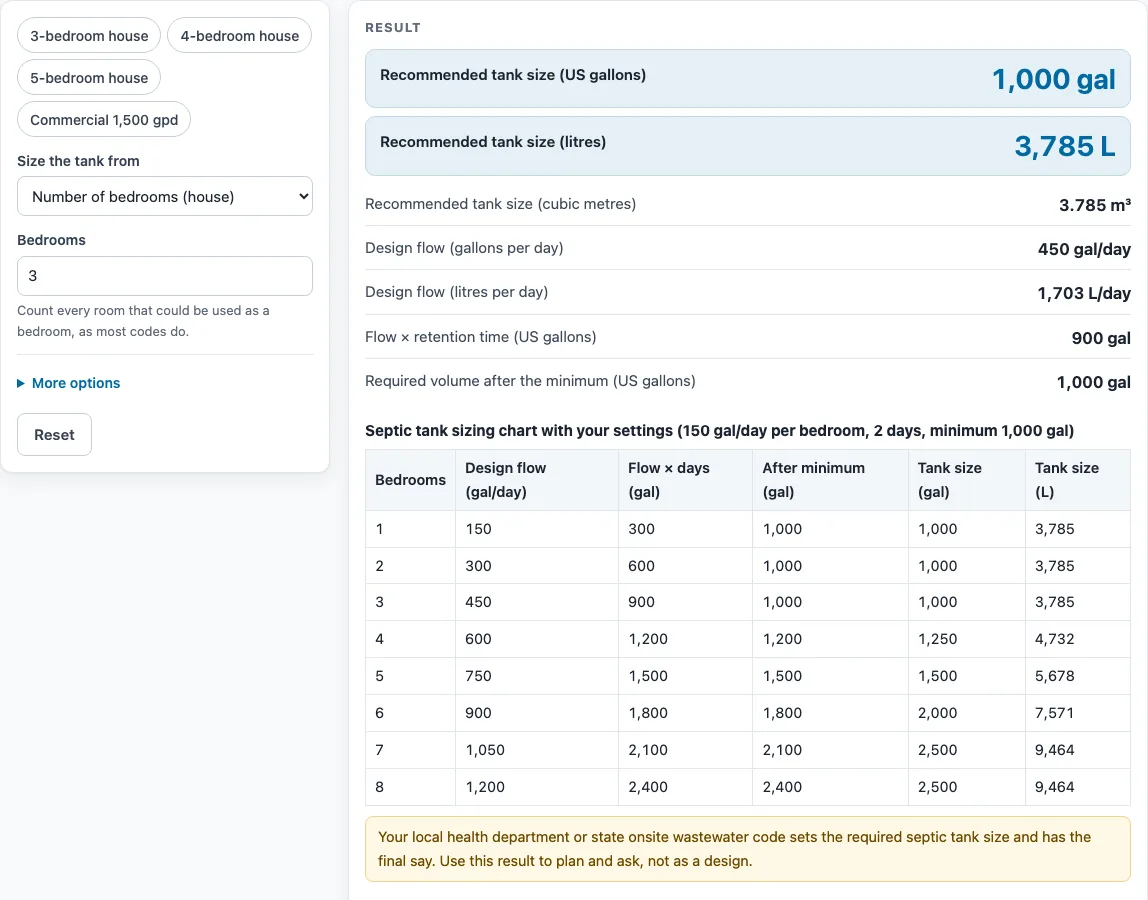
- Read the result: the recommended tank size in gallons, litres and cubic metres, the design flow, the flow × retention volume, and the required volume after the minimum is applied.
- Scroll to the sizing chart for 1 to 8 bedrooms, which uses your current settings.
- Open “How it was calculated” to check the formula and the values used.
Preset buttons above the form load typical cases: 3, 4 and 5-bedroom houses, and a commercial flow of 1,500 gal/day. Reset restores the starting example. Buttons under the result are Copy result, Copy link and Print / save as PDF.
How is septic tank size calculated?
This septic tank sizing method follows one rule. Tank volume equals the daily design flow multiplied by the retention time. If that volume is below the minimum tank size, the minimum is used instead. The result is then rounded up to a common size: 750, 1,000, 1,250, 1,500, 2,000, 2,500 or 3,000 gal. Above 3,000 gal, it rounds up to the next whole 1,000 gal. Precast sizes vary by manufacturer, so the nearest standard product may differ. The sizing chart under the result applies the same rule to 1 to 8 bedrooms with your current settings, so you can see where each house size crosses into the next tank size; with the defaults, 1 to 3 bedrooms stay at the 1,000 gal minimum, 4 bedrooms need 1,250 gal and 5 bedrooms need 1,500 gal.
For a house, the design flow is bedrooms × flow per bedroom. There is no single national figure for the flow per bedroom: Washington State uses 120 gal per bedroom per day and Hawaii uses 200, for example. The default of 150 is a mid-range starting value that you should replace with the number in your local code. For a 4-bedroom house, the design flow is 4 × 150 = 600 gal/day. Multiplied by 2 days, that gives 1,200 gal. This rounds up to a 1,250 gal tank (4,732 L).
How do you size a septic tank for a commercial building?
For non-residential work, use daily flow mode. A commercial flow of 1,500 gal/day with 2 days of retention needs 3,000 gal, so a 3,000 gal tank (11,356 L) is recommended. Flows can be entered in litres. For example, 3,000 L/day is 792.5 gal/day. With 2 days of retention, that needs 1,585 gal, which is rounded up to a 2,000 gal tank.
Sources
Checked October 2026:
- Washington WAC 246-272A-0230: 120 gallons per bedroom per day, 240 gallons per day minimum
- Illinois 77 Ill. Adm. Code 905, Illustration F: minimum tank 750 gal for 2 bedrooms or fewer, 1,000 for 3, 1,250 for 4, 1,500 for 5
- Tennessee Rule 0400-48-01-.08: 750 gal for 2 bedrooms or fewer, 900 for 3, 1,000 for 4
- Your own local code decides: change the flow per bedroom, retention time and minimum to match it
For estimation; verify critical designs against the applicable standard.
Worked examples
| Input | Result |
|---|---|
| 3 bedrooms at 150 gal/day, 2 days of retention | 900 gal needed, so a 1,000 gal tank (3,785 L) |
| 4 bedrooms at 150 gal/day, 2 days of retention | 1,200 gal needed, so a 1,250 gal tank (4,732 L) |
| 6 bedrooms at 150 gal/day, 2 days of retention | 1,800 gal needed, so a 2,000 gal tank (7,571 L) |
| 1500 gal/d design flow, 2 days of retention | 3,000 gal needed, so a 3,000 gal tank (11,360 L) |
| 3000 L/d design flow, 2 days of retention | 1,585 gal needed, so a 2,000 gal tank (7,571 L) |
Calculated by the tool above with these values.
Frequently asked questions
Can I use the results in commercial projects or client reports?
Yes, including quotes, design notes, reports and client projects, without attribution. Check the final design against the code that applies to your project.
Is the calculator free, and is anything I type uploaded?
Yes, it is free. Everything is calculated in your browser, nothing you type is uploaded, and there is no account or sign-up.
Can I print or share a calculation?
Yes. Print / save as PDF creates a one-page record with the inputs, the results, the calculation steps and the date. Copy link copies the page address, which stores every input in the ?s= part of the URL, so the same calculation reopens later or can be sent to a colleague.
Does this calculator replace my local code?
No. The local health department or state onsite wastewater code sets the required tank size, and a warning about this is always shown under the result.
Why does the chart show 1,000 gal for 1 to 3 bedrooms?
With the default settings, 1 to 3 bedrooms produce a volume below 1,000 gal. A 3-bedroom house needs 900 gal, which is under the 1,000 gal minimum, so the minimum applies.
Why is my result larger than the number I calculated?
The result is rounded up to the next common tank size. For example, 1,200 gal becomes a 1,250 gal tank, and 1,800 gal becomes 2,000 gal.
Does the calculator give a pump-out interval or size the drain field?
No. Published pump-out schedules depend on state tables and sludge accumulation data that this tool does not use. It also does not size the drain field.
Why do I see a warning when I enter my numbers?
Warnings appear for more than 8 bedrooms, a flow per bedroom outside 100 to 250 gal per day, or a retention time under 1 day. Bedrooms must be whole numbers, and flow, retention time and bedrooms must be positive.
Related tools
- Water Softener Size Calculator: use it to estimate the capacity of a softener for a household.
- Tank Size Calculator: use it to work out the volume of other tanks.
- Aquarium Volume Calculator: use it to find how much water a tank holds.
- Chlorine Dosage Calculator: use it to estimate how much chlorine to add to a water volume.
- Langelier Saturation Index Calculator (LSI): use it to check whether water is likely to scale or corrode.
- Pool Chlorine Calculator: use it to plan chlorine doses for a pool.
- Pool Salt Calculator: use it to estimate salt needed for a salt-chlorinated pool.
- All water treatment calculators: use it to browse every calculator in this set.