Salinity Calculator
Convert a conductivity, salinity or specific gravity reading of seawater or a reef tank into the other units at your water temperature.
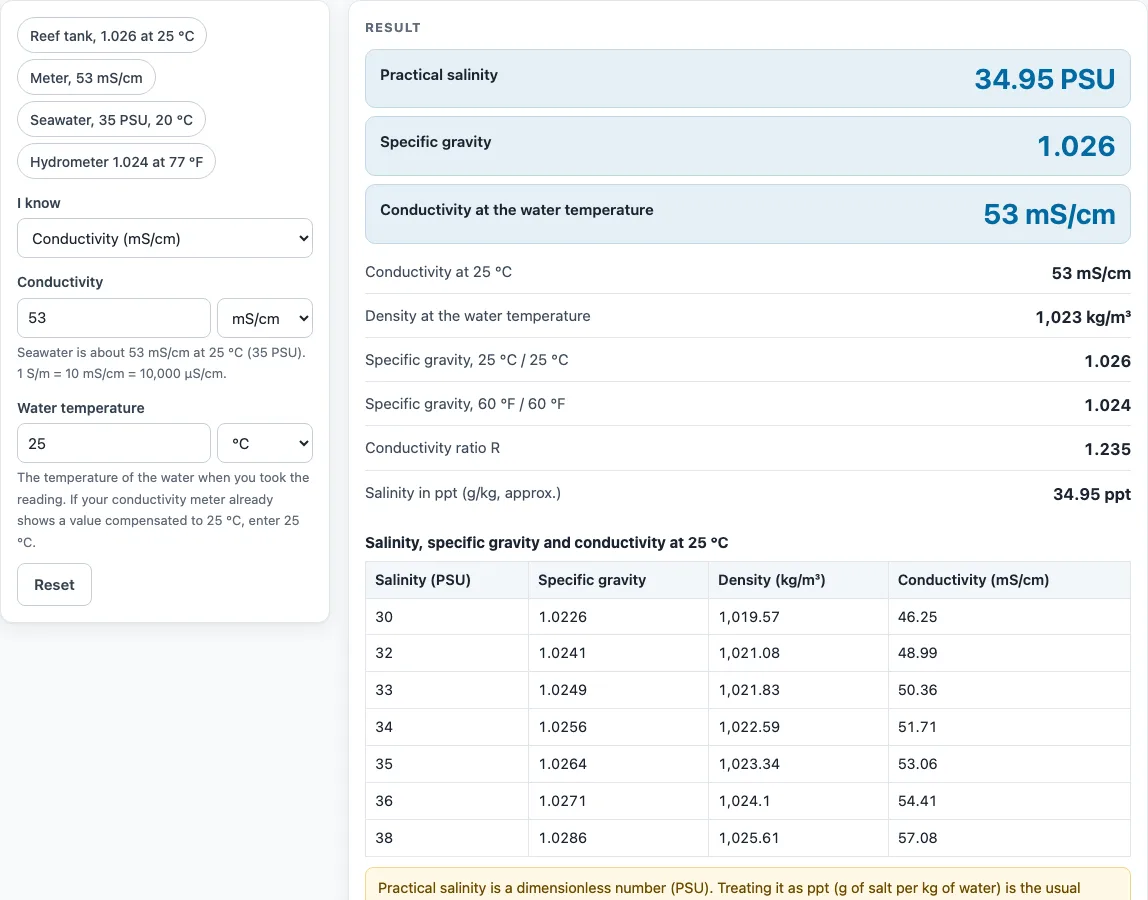
How to use the salinity calculator
- Under “I know”, choose the value you already have: conductivity (mS/cm, µS/cm or S/m), salinity, or specific gravity or density.
- Enter that value and pick its unit from the unit menu. You can mix metric and US customary units, because the tool converts them before calculating.
- Enter the water temperature in °C or °F. If your conductivity meter shows a value compensated to 25 °C, enter 25 °C.
- If you entered specific gravity, choose the reference temperature that matches your hydrometer: the same as the sample, 4 °C, 60 °F (15.56 °C), 20 °C or 25 °C.
- Read the results, which update as you type: practical salinity, salinity in ppt, conductivity at your temperature and at 25 °C, conductivity ratio, density and specific gravity. The table of salinity 30 to 38 shows how your reading compares.
- If a warning appears, check it. It shows when salinity is outside 2 to 42, when temperature is outside -2 to 35 °C, or when temperature is above 40 °C.
- Open “How it was calculated” under the result to see the formula, the values substituted and the answer with units.
The preset buttons load typical cases, and “Reset” returns to the starting example. “Copy result” copies the result lines with a link. “Copy link” copies the page address, which stores every input in the ?s= part of the URL, so the same calculation reopens later or can be sent to a colleague. “Print / save as PDF” prints a one-page record with the inputs, results, calculation steps and date.
What does the salinity calculator measure?
It works out four properties of seawater from one known value at a water temperature: practical salinity, conductivity, density and specific gravity. Pressure is fixed at the surface (0 dbar), so the results describe a sample at the surface, not deep water.
How is salinity worked out from conductivity?
The calculator first finds the conductivity ratio, R = C ÷ 42.914 mS/cm. The divisor is the conductivity of standard seawater with salinity 35 at 15 °C. It then applies the Practical Salinity Scale 1978 (PSS-78), using the Lewis and Perkin coefficients printed in UNESCO Technical Paper 44. Going the other way, from salinity to conductivity, the calculator inverts the same equations numerically with the Newton-Raphson method, as that paper describes.
What is specific gravity at 35 ppt salinity?
At 35 PSU and 25 °C, seawater has a density of 1023.343 kg/m³ and a specific gravity of 1.02637 when referenced to 25 °C. Specific gravity is the sample density divided by the density of pure water at the reference temperature. The density comes from the UNESCO 1981 equation of state (EOS-80) at surface pressure. The same sample gives a different specific gravity if the reference changes, so match the reference to your hydrometer’s label.
How accurate is the result for a reef tank?
The equations are written for seawater. Mixed salts, such as pool salt or aquarium mixes, can behave differently, so their results are approximate. Treating practical salinity as ppt (grams per kilogram) is the usual approximation, not an exact identity. A refractometer reads through its own calibration, which varies between makes, so check it against a calibration fluid before comparing it with the calculator’s output. As a check, a meter reading of 53 mS/cm at 25 °C gives 34.95 PSU and a specific gravity of 1.0263.
Sources
Checked October 2026:
- Practical Salinity Scale 1978 and the EOS-80 equation of state, with their check values: UNESCO Technical Papers in Marine Science 44 (1983), public copy; the calculator reproduces every check value in it
- Conductivity of standard seawater (S = 35, 15 °C, 0 dbar) = 42.914 mS/cm: TEOS-10 gsw_C3515
For estimation; verify critical designs against the applicable standard.
Worked examples
| Input | Result |
|---|---|
| 53 mS/cm at 25 °C | 34.95 PSU, SG 1.0263, 53 mS/cm |
| SG 1.026 at 25 °C | 34.51 PSU, SG 1.026, 52.4 mS/cm |
| SG 1.024 at 77 °F | 34.54 PSU, SG 1.024, 52.44 mS/cm |
| 35 PSU at 20 °C | 35 PSU, SG 1.0266, 47.91 mS/cm |
| 50000 µS/cm at 24 °C | 33.47 PSU, SG 1.0253, 50 mS/cm |
Calculated by the tool above with these values.
Frequently asked questions
Can I use the results in commercial projects or client reports?
Yes. Results may be used in commercial work, including quotes, design notes, reports and client projects, without attribution. The result note reads “For estimation; verify critical designs against the applicable standard,” so check any critical design against the standard that applies to it.
Is the calculator free, and is anything I type uploaded?
The calculator is free and needs no account or sign-up. Everything is calculated in your browser, and nothing you type is uploaded.
Can I print or share a calculation?
Yes. “Print / save as PDF” produces a one-page record with the inputs, results, calculation steps and date. “Copy link” copies a page address that stores every input, so anyone who opens it sees the same calculation. “Copy result” copies the result lines with a link.
What specific gravity should a reef tank have?
The calculator does not set a target. It converts the reading you have: for example, a specific gravity of 1.026 at 25 °C (relative to pure water at 25 °C) works out to 34.51 PSU. Use the target your livestock or supplier recommends.
Can I use it to dose salt for a swimming pool?
No. This tool is for seawater and reef tanks. For adding salt to a swimming pool chlorinator, use the pool salt calculator.
Related tools
- TDS calculator: use it to estimate total dissolved solids from a conductivity reading when your water is not seawater.
- Pool salt calculator: use it to work out how much salt to add to a swimming pool.
- Aquarium volume calculator: use it to find the water volume of a tank before you mix salt water.
- Water hardness chart: use it to convert hardness readings between common units.
- Langelier saturation index calculator: use it to estimate whether water tends to scale or corrode pipes and surfaces.
- All water treatment calculators: use it to browse every calculator on the site.