Rainwater Harvesting Calculator
Enter the roof area, the rainfall and the roof material to see how much rainwater you can collect, and size a cistern from monthly rainfall and demand.
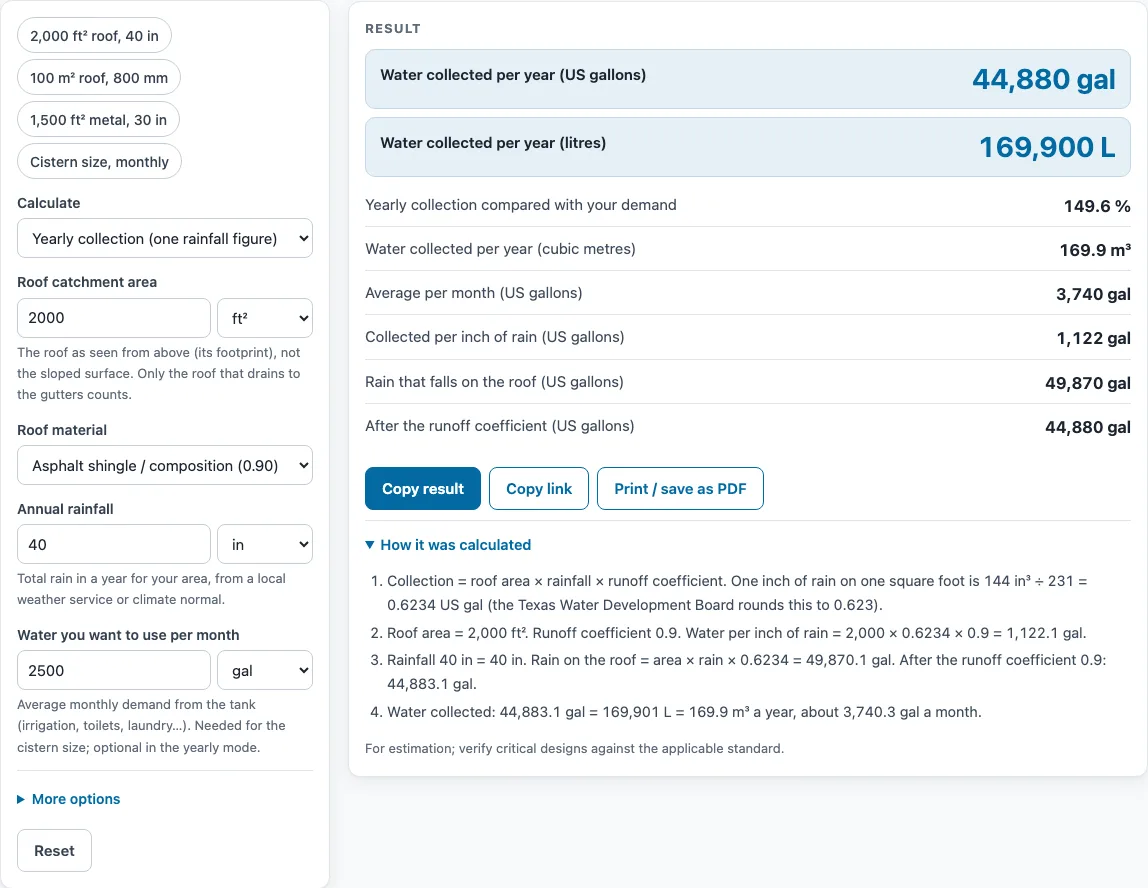
How to use the Rainwater Harvesting Calculator
- Choose a preset button above the form to load a typical case, or start from the example already in the form. Reset restores the starting example at any time.
- Enter the catchment area, which is the roof as seen from above. Pick ft², m² or yd² from its unit menu.
- Choose the roof material. It sets the runoff coefficient. If your roof does not match the list, choose a custom value between 0 and 1.
- Enter the annual rainfall in inches, mm or cm, using its unit menu.
- For a month-by-month result, set Calculate to Month by month, with cistern size and type twelve rainfall numbers, January to December, separated by spaces or commas. Use your own monthly averages.
- Enter your water demand per month in gal, L or m³ to compare collection with use and to get a cistern size.
- Open More options to add a first-flush loss or to type your own cistern capacity.
- Read the result, which updates as you type. Open “How it was calculated” to see the formula, the values substituted and the answer with units.
Copy result copies the result lines with a link. Copy link copies the page address, which stores every input in the ?s= part of the URL, so the same calculation reopens later or can be sent to a colleague. Print / save as PDF creates a one-page record with the inputs, results, calculation steps and date.
How much rain can a roof collect?
A roof collects the rain that falls on its footprint, minus the share that is lost before it reaches the tank. The calculator multiplies three values: catchment area × rainfall × runoff coefficient.
One inch of rain falling on one square foot gives 144 in³ ÷ 231 in³ per US gallon = 0.6234 US gallons. The Texas Water Development Board’s Texas Manual on Rainwater Harvesting uses the rounded figure 0.62. So a 2,000 ft² roof with 40 in of rain collects about 2,000 × 40 = 80,000 ft·in of rain. Multiplied by a 0.90 runoff coefficient and 0.6234, that gives about 44,900 US gallons, or roughly 170,000 litres, a year.
The runoff coefficient depends on the roof material: metal 0.95, asphalt shingle or composition 0.90, clay or concrete tile 0.90, and gravel or flat built-up roof 0.80. The metal, asphalt and concrete values and the 0.80–0.85 range for tar and gravel are the estimates in the New Mexico Office of the State Engineer’s Roof-Reliant Landscaping guide (Table 7-1); this tool uses 0.80 for gravel, and clay tile is assumed to behave like concrete tile. Real roofs vary with condition and slope, and the Texas manual suggests planning on an overall efficiency of 75 to 90 percent.
First flush is water you choose to discard at the start of each rain, because it carries dust and debris from the roof. The Texas manual gives a rule of thumb of at least 10 gallons per 1,000 ft² of roof for each rain event, and elsewhere suggests 1 to 2 gallons per 100 ft². The tool subtracts this loss from the yearly total. In monthly mode, the yearly loss is spread over the months in proportion to their rainfall.
How is a cistern size worked out?
The suggested cistern size uses the Rippl mass-curve method. It finds the largest cumulative shortfall of supply against demand over a repeating year, which is the storage needed to carry water through the driest stretch.
The size exists only if yearly collection is at least the yearly demand. If collection is lower, no tank can meet all of the demand. The tool then shows a warning and gives the size that stores every drop collected, with no overflow.
The month table shows rainfall, collected water, demand, water stored at month end, overflow and shortfall for each month. In the example with 2,000 ft² of shingle roof, 2,500 gal of monthly demand and 32,204 gal collected a year, the Rippl cistern is 7,002 gal. That tank meets all of the demand, and about 2,204 gal overflows in a year.
Sources
Checked October 2026:
- Texas Water Development Board, Texas Manual on Rainwater Harvesting, 3rd ed.: 0.62 gallons per square foot per inch, first flush of at least 10 gallons per 1,000 ft², 75 to 90 percent overall efficiency
- New Mexico Office of the State Engineer, Roof-Reliant Landscaping, Table 7-1: runoff coefficients for common roof materials (estimates)
- Cistern size by the Rippl mass-curve method
For estimation; verify critical designs against the applicable standard.
Worked examples
| Input | Result |
|---|---|
| 2000 ft², asphalt shingle roof, 40 in of rain a year | 44,880 gal (169,900 L) collected a year |
| 100 m², metal roof, 800 mm of rain a year | 20,080 gal (76,000 L) collected a year |
| 1500 ft², metal roof, 30 in of rain a year | 25,900 gal (98,040 L) collected a year |
| 2000 ft², asphalt shingle roof, monthly rainfall table, demand 2500 gal a month | 32,200 gal (121,900 L) collected a year, cistern size 7,002 gal |
| 150 m², tile roof, monthly rainfall table, demand 6 m³ a month | 24,430 gal (92,480 L) collected a year, cistern size 13.13 m³ |
Calculated by the tool above with these values.
Frequently asked questions
Can I use the results in commercial projects or client reports?
Yes. Results may be used in commercial work, including quotes, design notes, reports and client projects, without attribution. The page marks results as estimates, so verify critical designs against the applicable standard.
Is the calculator free, and is anything I type uploaded?
Yes, the calculator is free and needs no account or sign-up. Everything is calculated in your browser, and nothing you type is uploaded.
Can I print or share a calculation?
Yes. Print / save as PDF creates a one-page record with the inputs, results, calculation steps and date. Copy link gives a URL that stores all your inputs, so the same calculation reopens for you or a colleague.
Why is no cistern size shown?
A cistern size is only calculated when yearly collection is at least yearly demand. If it is lower, a warning appears, and the size shown stores every drop collected, with no overflow.
Why does the calculator warn about my annual rainfall?
Annual rain over 400 in is flagged as a likely unit mistake. Check whether you entered millimetres or centimetres into the inch field. The tool also warns when first-flush loss is larger than the water collected or the roof area is over 1,000,000 ft².
What does the month table show?
It shows, for each month, the rainfall, water collected, demand, water stored at month end, overflow and shortfall, in the unit of your demand. Type your own cistern capacity under More options to see the overflow, shortfall and share of demand that tank meets.
Related tools
- Tank Size Calculator — use it to find the volume of a tank with known dimensions and compare it with the cistern size from this tool.
- Aquarium Volume Calculator — use it to work out how much water a fish tank holds.
- Pool Volume Calculator — use it to find out how much water a pool holds before filling or treating it.
- Pool Chlorine Calculator — use it to estimate chlorine needs for a pool.
- Chlorine Dosage Calculator — use it to work out a chlorine dose for a given volume of water.
- Pool Salt Calculator — use it to estimate the salt needed for a salt-water pool.
- Langelier Saturation Index Calculator — use it to check whether water is likely to scale or corrode.
- All water treatment calculators — browse the full set of water treatment tools.