Pool Volume Calculator
Choose the pool shape and enter its size and depth to get the gallons and litres of water, the pump flow for a turnover time and how long it takes to fill.
How to use the Pool Volume Calculator
- Under Pool shape, choose rectangle, round, oval, kidney or L-shape. To start from a typical case, click one of the preset buttons above the form.
- Pick a unit for each dimension from its menu. You can use ft, in, m, cm or yd, and you can mix metric and US units.
- Enter the dimensions shown for your shape: length and width, diameter, kidney widths A and B with the overall length, or the length and width of both rectangles for an L-shape.
- Under Pool depth, use one constant water depth, or enter a shallow-end depth and a deep-end depth.
- Read the results: the volume in US gallons, litres, cubic metres and Imperial gallons, plus the surface area and the average depth.
- Open “How it was calculated” under the result to see the formula, the values substituted and the answer with units.
- If you need different settings, open More options to change the turnover time (default 8 hours) or the hose flow rate (default 10 gpm).
Copy result copies the result lines with a link. Copy link copies the page address, which holds every input. Print / save as PDF produces a one-page record. Reset restores the starting example.
How do you determine pool volume?
Pool volume is the surface area multiplied by the average depth of the water. Find the surface area from the pool’s shape, find the average depth, then multiply the two. The result is in cubic units, which the calculator converts to gallons and litres using exact factors.
The factors are 1 ft³ = 28.316846592 L = 7.4805 US gal, 1 US gal = 3.785411784 L, and 1 Imp gal = 4.54609 L.
How do you calculate the volume of a pool (calculating the volume of a pool)?
To compute pool gallons, use the surface area formula for your shape, then multiply by the average depth. The same two steps work for all pool sizes, so you can measure once and compare. For a rectangle, the area is L × W. For a round pool it is π × D² ÷ 4. For an oval it is π × L × W ÷ 4, which equals 0.7854 × L × W. For an L-shape, add L₁ × W₁ and L₂ × W₂.
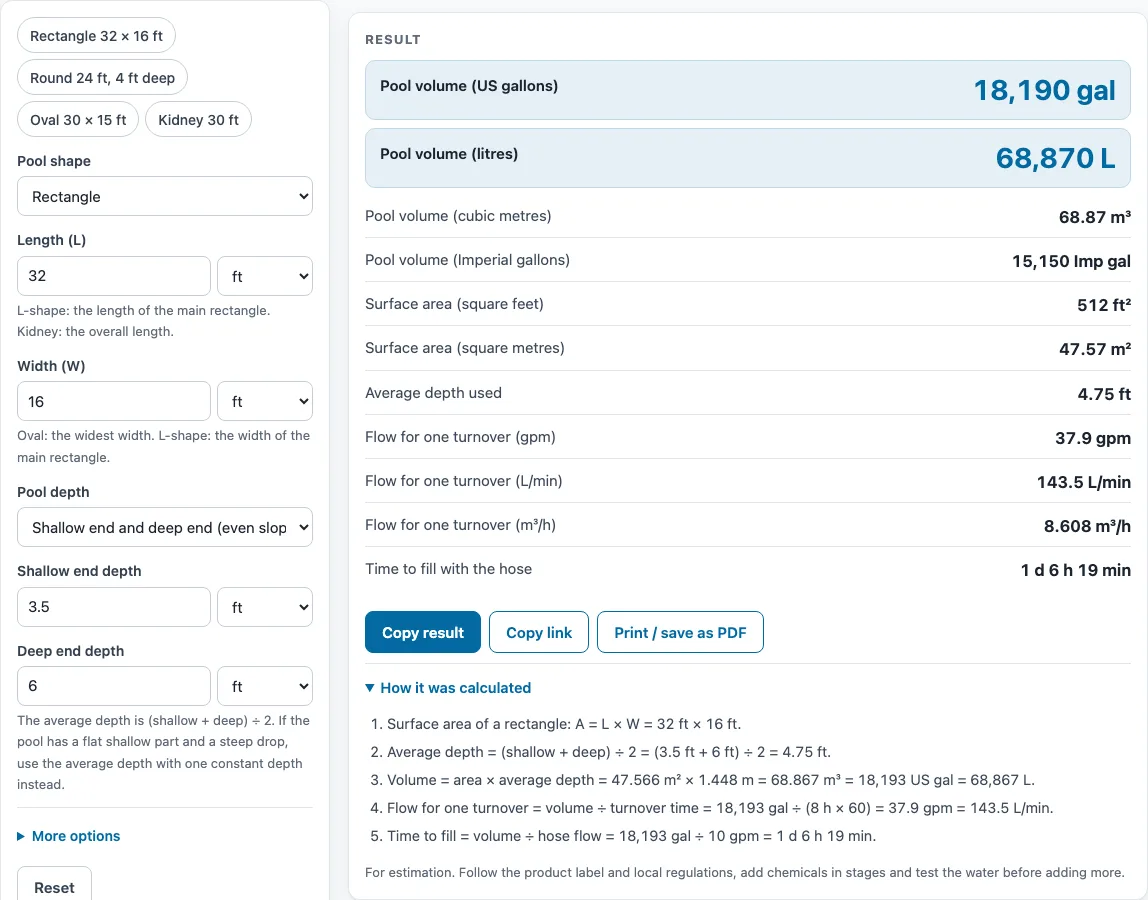
For example, a 32 ft × 16 ft rectangle with an average depth of 4.75 ft has a volume of 2,432 ft³, which holds 18,193 US gal.
How do you calculate volume of a swimming pool with a sloped floor?
For a floor that slopes evenly from shallow to deep, the average depth is (shallow + deep) ÷ 2. A pool 3.5 ft deep at the shallow end and 6 ft at the deep end has an average depth of 4.75 ft.
If the pool has a flat shallow section and a steep drop, the simple average can be misleading. Work out its own average depth and enter it as one constant depth.
Why is the kidney shape only an estimate?
The kidney shape uses the pool-industry rule of thumb for surface area: (A + B) × L × 0.45. It is an approximation, typically within about 10 % either way, so the calculator shows a warning each time you select it. For a kidney pool with L 30 ft, A 15 ft, B 10 ft and a depth of 4 ft, the result is about 10,100 gal.
What do turnover time and fill time mean?
Turnover time is how long the pump takes to circulate the full pool volume once. The flow for one turnover is the pool volume divided by the turnover time. The 18,193 gal rectangle above needs 37.9 gpm for an 8-hour turnover. The result is a starting point for sizing a pump and filter, and a warning appears if the turnover time is under 4 hours.
Fill time is the pool volume divided by the hose flow rate. A 10 gpm hose takes 1 day 6 hours 19 minutes to fill that same pool.
Sources
Checked October 2026:
- Standard mensuration formulas for rectangles, circles, ellipses and frustums; 1 ft³ = 7.4805 US gal, NIST SP 811
- The kidney-pool factor 0.45 is a pool-industry rule of thumb, not a standard
For estimation; verify critical designs against the applicable standard.
Worked examples
| Input | Result |
|---|---|
| rectangular pool, L 32 ft, W 16 ft, depth 3.5 ft to 6 ft | 18,190 gal (68,870 L), pump flow 37.9 gpm for a 8 h turnover |
| round pool, D 24 ft, depth 4 ft | 13,540 gal (51,240 L), pump flow 28.2 gpm for a 8 h turnover |
| oval pool, L 30 ft, W 15 ft, depth 3 ft to 6 ft | 11,900 gal (45,040 L), pump flow 24.8 gpm for a 8 h turnover |
| kidney pool, L 30 ft, A 15 ft, B 10 ft, depth 4 ft | 10,100 gal (38,230 L), pump flow 21 gpm for a 8 h turnover |
| rectangular pool, L 10 m, W 5 m, depth 1.5 m | 19,810 gal (75,000 L), pump flow 41.3 gpm for a 8 h turnover |
Calculated by the tool above with these values.
Frequently asked questions
Can I use the results in commercial projects or client reports?
Yes. Results may be used in commercial work, such as quotes, design notes, reports and client projects, without attribution. The page note reads: “For estimation; verify critical designs against the applicable standard.”
Is the calculator free, and is anything I type uploaded?
Yes, the calculator is free. Everything is calculated in your browser, nothing you type is uploaded, and there is no account or sign-up.
Can I print or share a calculation?
Yes. Print / save as PDF creates a one-page record with the inputs, results, calculation steps and date. Copy link copies the page address, which stores every input in the ?s= part of the URL, so the same calculation reopens later or can be sent to a colleague.
Should I enter the water depth or the wall height of an above-ground pool?
Enter the water depth. The volume is of the water at the depth you enter, not of the pool shell. An above-ground pool is normally filled a few inches below the top of the wall.
Why does the calculator warn that the average depth is over 3.5 m?
An average depth over 3.5 m usually means a unit mistake, such as feet entered as metres. Check the unit menu next to the depth field. The calculator also warns if the deep end is shallower than the shallow end.
Can I mix metric and US units in one calculation?
Yes. Each quantity has its own unit menu, and the tool converts everything before it calculates.
Why is my pump flow different from the example?
The pump flow depends on the turnover time. The default is 8 hours, so change it under More options if your target is different.
Related tools
- Aquarium Volume Calculator: Use it to find the water volume of an aquarium.
- Pool Chlorine Calculator: Use it to estimate chlorine for your pool’s water volume.
- Pool Salt Calculator: Use it to estimate salt needed for a salt-chlorinated pool.
- Tank Size Calculator: Use it to work out the volume of a tank of any shape.
- Chlorine Dosage Calculator: Use it to work out how much chlorine to add to a body of water.
- Langelier Saturation Index Calculator: Use it to check whether pool water is likely to scale or corrode.
- Rainwater Harvesting Calculator: Use it to estimate how much rainwater a roof can collect.
- All water treatment calculators: Use this list to browse every water treatment calculator on the site.