Pool Salt Calculator
Enter the pool volume, the current salt reading and the target level to get the pounds or kilograms of salt and the number of bags to add.
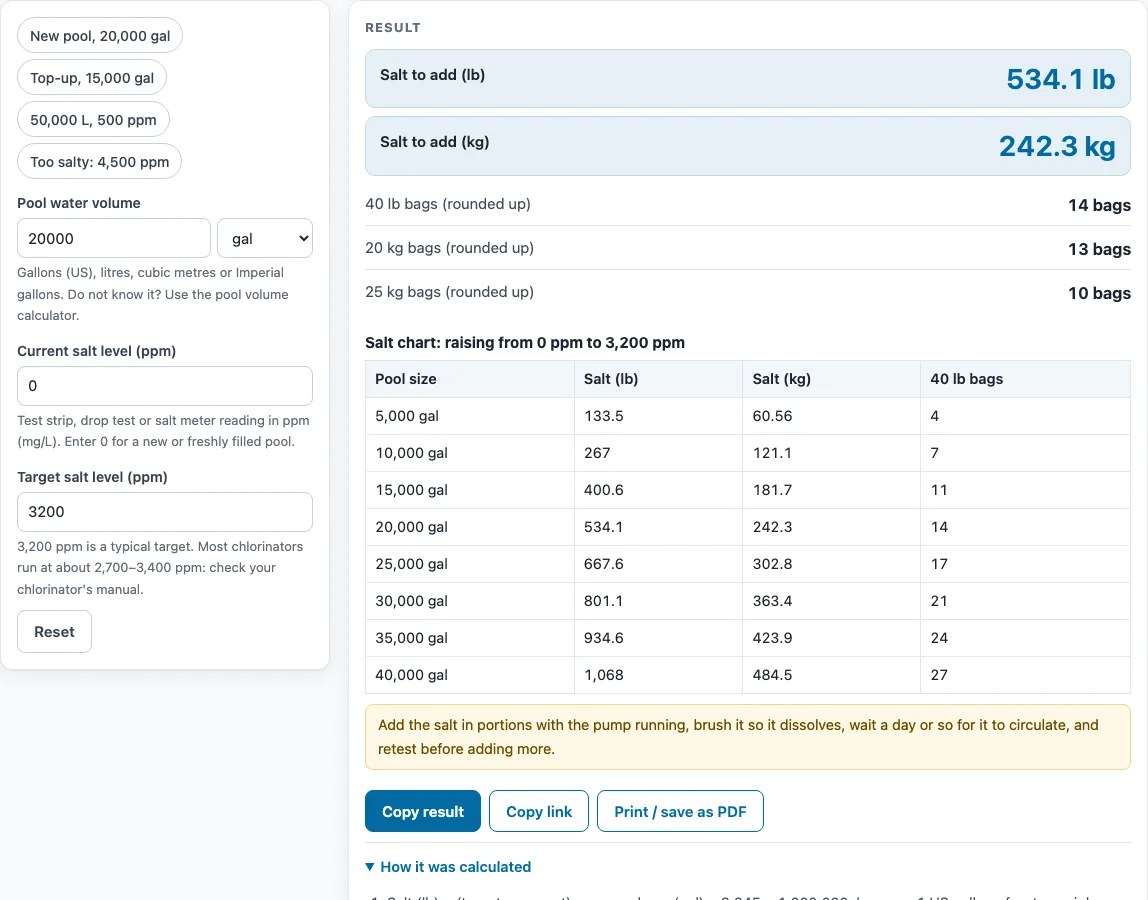
How to use the Pool Salt Calculator
- Enter the pool water volume. Choose its unit from the unit menu next to the field: gallons, litres, cubic metres or Imperial gallons. The default is 20,000 gal.
- Enter the current salt level in ppm. Use 0 for a new or freshly filled pool.
- Enter the target salt level in ppm. The default is 3,200 ppm.
- Read the result. It shows the salt to add in pounds and kilograms, plus the number of 40 lb, 20 kg and 25 kg bags, each rounded up to whole bags. If the current level is above the target, the result shows the percent of water to drain and replace instead.
- Open “How it was calculated” under the result to see the formula, the values substituted and the answer with units.
- Check the two tables. The salt chart covers pools from 5,000 to 40,000 gallons. If the current level is above 0, a second chart shows a new pool from 0 ppm to your target.
- Read any warning before you add salt.
Preset buttons above the form load typical cases: a new pool, a top-up, 50,000 L from 500 ppm, or a pool that is too salty. Less common inputs are under More options, and Reset restores the starting example.
How do you calculate salt for a pool?
The calculator works out the mass of salt needed to raise the concentration by the gap between the target and the current level. Ppm for water equals mg/L, so the salt needed is that concentration change multiplied by the water volume, then divided by 1,000,000 to convert milligrams into the output unit.
For US customary units, the formula is salt (lb) = (target − current) ppm × volume (gal) × 8.345 ÷ 1,000,000. One US gallon of water weighs about 8.345 lb, which turns the volume into pounds of water. For metric units, the formula is salt (kg) = (target − current) ppm × volume (L) ÷ 1,000,000, because one litre of water weighs about 1 kg.
Take 20,000 gal from 0 to 3,200 ppm: 3,200 × 20,000 × 8.345 ÷ 1,000,000 = 534.1 lb. Dividing by 2.2046 gives 242.3 kg. Bags are rounded up: 534.1 ÷ 40 is 13.35, so 14 bags.
Each quantity has its own unit menu, so you can mix metric and US units. The tool converts them before it calculates.
How much salt per 1,000 gallons raises salinity?
From the same formula, raising 1,000 gallons of water by 1,000 ppm takes 8.345 lb of salt. So a new pool going from 0 to 3,200 ppm needs about 26.7 lb per 1,000 gallons, and a top-up from 2,800 to 3,200 ppm needs about 3.3 lb per 1,000 gallons. In metric, 1,000 ppm in 1,000 litres is exactly 1 kg, so 3,200 ppm needs 3.2 kg per 1,000 litres. Use the salt chart under the result for whole pool sizes, or Copy link to keep the calculation and Print / save as PDF for a dated record.
Sources
Checked October 2026:
- Dosing relation: mass = concentration × volume, with water at 8.345 lb per US gallon
- Target salinity comes from your salt chlorine generator’s owner’s manual; the 2,700 to 3,400 ppm warning range is a commonly quoted residential range, not a standard
For estimation; verify critical designs against the applicable standard.
Worked examples
| Input | Result |
|---|---|
| 20000 gal, from 0 ppm to 3200 ppm | Add 534.1 lb (242.3 kg), about 14 bags of 40 lb |
| 15000 gal, from 2000 ppm to 3200 ppm | Add 150.2 lb (68.13 kg), about 4 bags of 40 lb |
| 12000 gal, from 2800 ppm to 3200 ppm | Add 40.06 lb (18.17 kg), about 2 bags of 40 lb |
| 50000 L, from 500 ppm to 3200 ppm | Add 297.6 lb (135 kg), about 8 bags of 40 lb |
| 20000 gal, from 4500 ppm to 3200 ppm | Drain and replace 28.9 % (5,778 gal) |
Calculated by the tool above with these values.
Frequently asked questions
Can I use the results in commercial projects or client reports?
Yes. Results may be used in commercial work, including quotes, reports and client projects, without attribution. The note under the result reads: “For estimation. Follow the product label and local regulations, add chemicals in stages and test the water before adding more.”
How much salt does a new 20,000 gallon pool need?
Enter 0 ppm as the current level and 3,200 ppm as the target. The result is 534.1 lb (242.3 kg), which is about 14 bags of 40 lb, 13 bags of 20 kg or 10 bags of 25 kg.
What target salt level should I enter?
3,200 ppm is a typical target. Most salt chlorine generators run at about 2,700 to 3,400 ppm, so check your chlorinator’s manual and enter the level it specifies. The calculator shows a warning when the target is outside that range.
Why does the calculator warn that my current level is above 10,000 ppm?
A reading that high often means a unit or meter mistake. Check the reading and the unit menu before you use the result.
What if my pool is too salty?
Use the drain-and-replace result rather than adding salt. The calculator assumes your refill water contains no salt. If your source water already has salt, the level after refilling will be a little higher than the result predicts.
What does the salt chart show?
The main chart covers pools from 5,000 to 40,000 gallons, in steps of 5,000, and shows the salt needed from your current level to your target. Each row gives pounds, kilograms and 40 lb bags.
Does the result allow for salt purity, existing salt or evaporation?
No. The result is an estimate. It does not account for salt purity, salt already dissolved in the fill water, or evaporation. Retest the water after the salt has circulated.
Related tools
- Pool Chlorine Calculator: use it to work out the chlorine dose for your pool water.
- Pool Volume Calculator: use it to find your pool’s volume before you enter it here.
- Tank Size Calculator: use it to work out the volume of a tank or vessel.
- Aquarium Volume Calculator: use it to find the water volume of an aquarium.
- Chlorine Dosage Calculator: use it to estimate how much chlorine to dose for a given water volume.
- Langelier Saturation Index Calculator (LSI): use it to check whether your pool water is likely to be scaling or corrosive.
- Rainwater Harvesting Calculator: use it to estimate how much rainwater a roof can collect.
- All water treatment calculators: use it to browse every calculator in this group.