Pool Pump Size Calculator
Enter the pool volume and turnover time to get the pump flow you need, the daily run time for your pump and a pipe-size check.
This Pool Pump Size Calculator finds the pump flow you need to turn your pool water over in a chosen time. Enter your pool volume and turnover time, and it shows the flow in gpm, L/min and m³/h.
It also works as a pool pump run time calculator. Enter a pump’s flow and it gives the hours one turnover takes and the daily run time for the number of turnovers you want.
A pipe-size check shows the smallest PVC suction and return pipe that keeps water speed under the limit you choose. The calculator runs in your browser, is free, and needs no account or sign-up.
How to use the Pool Pump Size Calculator
- Enter the pool volume. Use the unit menu next to the field to choose US gallons, litres, cubic metres, Imperial gallons or cubic feet.
- Set the turnover time in hours. For a quick start, use a preset button above the form: 24 h (home), 6 h (public) or 2 h (activity pool).
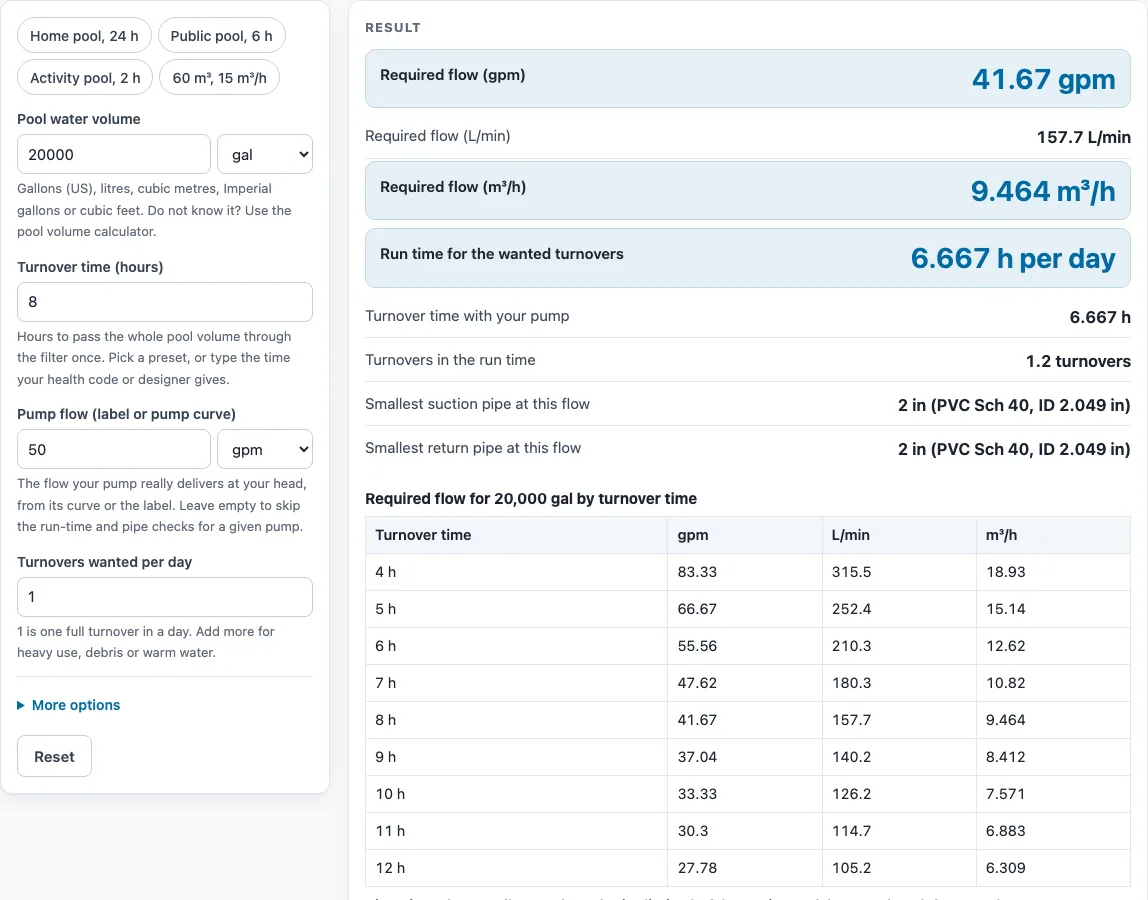
- Read the required flow in gpm, L/min and m³/h. The table beside the result lists the flow for turnover times from 4 to 12 hours at your volume.
- Enter your pump’s flow from its label or pump curve. The result shows how many hours one turnover takes and the run time for the number of turnovers you want per day.
- Optionally, enter the pump run hours per day. The calculator returns the number of turnovers that pump will achieve.
- Open the pipe-size check. Choose a velocity limit, such as the MAHC public pool limits, the Washington State residential limit, or a custom value. It shows the smallest PVC Schedule 40 suction and return pipe, from 1½ to 4 in, that keeps water speed under the limit.
- Open “How it was calculated” under the result to check the formula, the values used and the answer with units.
Results update as you type. Use “More options” for the less common inputs, and “Reset” to return to the starting example.
What size pump do I need for my pool?
Divide the pool volume by the turnover time you want. That gives the flow the pump must deliver: flow = volume ÷ turnover time. For 20,000 gal with an 8 h turnover, the flow is 2,500 gal per hour, or 41.67 gpm.
How long should I run my pool pump?
Run time depends on your pump’s flow and the number of turnovers you want each day: run time = turnovers × volume ÷ pump flow. A 50 gpm pump moves 3,000 gal per hour, so one turnover of 20,000 gal takes 6.67 hours. Two turnovers would take 13.33 hours.
How do I calculate pool turnover rate?
Turnover rate is the number of times the pump moves the full pool volume in a day. Use turnovers = flow × hours ÷ volume, with flow in gallons per hour. A 50 gpm pump running 8 hours moves 24,000 gal, which is 1.2 turnovers of a 20,000 gal pool.
What is a good turnover time for a pool?
For a residential pool, the DOE Building America Solution Center (PNNL) says the pump should turn the pool over at least once every 24 hours. That means a minimum flow of pool gallons ÷ 1,440 gpm. It also says a turnover under six hours is not wanted in normal operation.
Public pools have maximum turnover times set by the 2023 Model Aquatic Health Code (US CDC): 6 hours for most pools, 8 hours for diving pools, 2 hours for activity pools, lazy rivers and wave pools, and 1 hour for wading pools, plunge pools and runout slides.
What size pipe do I need for my pool pump?
Pipe size is set by water speed, not just pump flow. Pipe flow at a speed limit is Q = v × π × ID² ÷ 4, using inside diameters from the JM Eagle ASTM D1785 data sheet. A 2 in Schedule 40 pipe carries at most 82.2 gpm (18.7 m³/h) at 8 ft/s, so a 41.67 gpm flow fits within a 2 in pipe at that residential limit.
The pipe check looks at water speed only. It does not calculate head loss or suction-outlet needs.
Sources
Checked October 2026:
- Residential turnover (at least once in 24 hours; under 6 hours not wanted in normal operation): DOE Building America Solution Center (PNNL), variable-speed pool pumps
- Public pool turnover times and pipe velocity limits (suction 6 ft/s, return 8 ft/s): CDC 2023 Model Aquatic Health Code, 4.7.1.10 and 4.7.1.7.2
- Residential 8 ft/s limit: Washington State pool rules (2021), §311.3.2, via UpCodes
- PVC Schedule 40 inside diameters (ASTM D1785): JM Eagle solvent-weld schedule data sheet
For estimation; verify critical designs against the applicable standard.
Worked examples
| Input | Result |
|---|---|
| 20000 gal, 8 h turnover | Needs 41.67 gpm (9.464 m³/h); 1 turnover(s) a day take 6.67 h of pump time |
| 15000 gal, 6 h turnover | Needs 41.67 gpm (9.464 m³/h); 2 turnover(s) a day take 8.33 h of pump time |
| 80 m³, 6 h turnover | Needs 58.7 gpm (13.33 m³/h) |
| 40000 L, 8 h turnover | Needs 22.01 gpm (5 m³/h); 1.5 turnover(s) a day take 3.33 h of pump time |
Calculated by the tool above with these values.
Frequently asked questions
Can I use the results in commercial projects or client reports?
Yes. Results may be used in commercial work, including quotes, design notes, reports and client projects, without attribution. The page note still applies: “For estimation; verify critical designs against the applicable standard.”
Is the calculator free, and is anything I type uploaded?
The calculator is free. Everything is calculated in your browser, so nothing you type is uploaded. There is no account or sign-up.
Can I print or share a calculation?
Yes. “Print / save as PDF” creates a one-page record with the inputs, results, calculation steps and date. “Copy link” copies the page address, which stores every input in the ?s= part of the URL, so the calculation can be reopened later or sent to a colleague. “Copy result” copies the result lines with a link.
Can I mix metric and US units?
Yes. Each quantity has its own unit menu, so you can enter volume in litres and read flow in gpm in the same calculation. The tool converts the units before it calculates.
Why is my pump’s real flow lower than the label?
Use the flow your pump delivers at your system’s head (filter, valves and pipe included), read from its pump curve. The page warns that the real flow is lower than the free-flow figure on the label. If you size from the label alone, your turnover time may be longer than the result shows.
Related tools
- Pool volume calculator: Use this first if you do not yet know your pool’s volume in gallons, litres or cubic metres.
- Pool filter size calculator: Use this to check whether your filter can handle the flow your pump delivers.
- Pool heater calculator: Use this to estimate the heater size for your pool.
- Pool chemical calculator: Use this to work out how much chemical to add for your pool volume.
- Pool evaporation calculator: Use this to estimate how much water your pool loses to evaporation.
- All water treatment calculators: Use this to browse every calculator on the site.