Pool Heater Calculator
Enter the pool volume, start and target temperature and heat-up time to get the heater size in BTU/h and kW, the time and the cost.
How to use the pool heater calculator
- Pick a preset button above the form to load a typical case, or start with the example already in the form.
- Enter the pool volume. Use the unit menu beside the field to choose gallons, litres, cubic metres, Imperial gallons or cubic feet.
- Enter the starting and target water temperatures, and choose °F or °C from the unit menu.
- Enter the heat-up time in hours.
- Enter your heater’s efficiency (the form starts with an example value). Check the heater’s documentation for the real figure.
- Optionally, enter your energy price per therm or per kWh to see the cost of one heat-up, and the pool surface area and coldest-month air temperature for the DOE outdoor method.
- Optionally, enter a heater size in BTU/h or kW, as an input or output rating, to see how many hours it needs to heat the pool.
- Read the result. Open “How it was calculated” under the result to see the formula, the values substituted and the answer with units.
Less common inputs are under “More options”. Each quantity has its own unit menu, so you can mix metric and US customary units in one calculation; the tool converts them before calculating. “Reset” returns the form to the starting example.
What size pool heater do I need?
Start with the heat-up method if you have a set time, such as 24 hours. Divide the heat needed by the hours to get the output in BTU/h, then divide that by efficiency to get the input rating. For outdoor pools, the US DOE method gives a second estimate: pool surface area in ft² × temperature rise × 12 = heater output in BTU/h. The temperature rise is the desired pool temperature minus the average air temperature of the coldest month you will use the pool.
The DOE formula assumes a rise of 1 to 1¼ °F per hour and a 3½ mph average wind at the pool surface. DOE’s wording says to multiply by 1.5 for a 1½ °F rise and by 2.0 for a 2 °F rise. For a 512 ft² pool (16 × 32 ft) raised to 80 °F with 60 °F coldest-month air, the rise is 20 °F, so 512 × 20 × 12 = 122,880 BTU/h. DOE advises having a trained pool professional do a proper sizing analysis.
How many BTU to heat a pool?
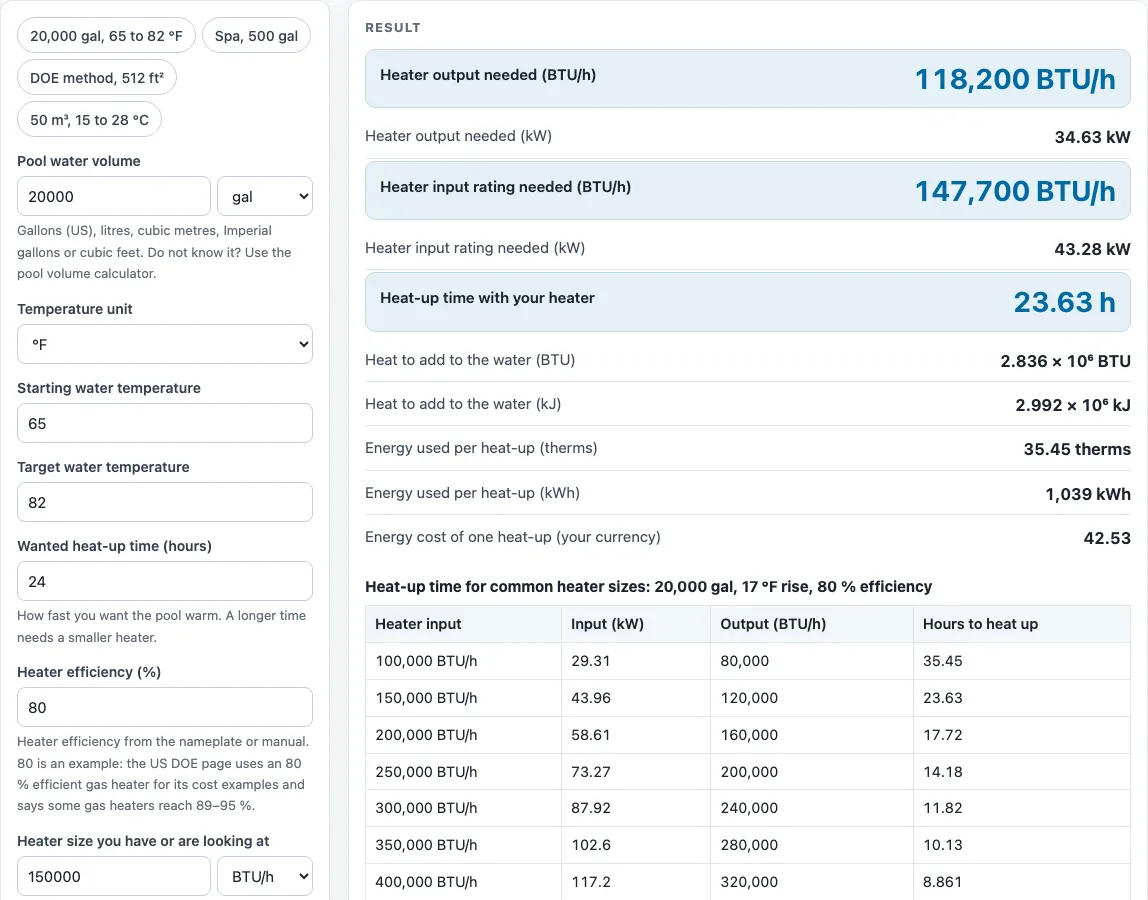
Heat needed = gallons × 8.34 lb/gal × temperature rise in °F. This works because one BTU warms one pound of water by one °F. For 20,000 gal heated from 65 to 82 °F, the rise is 17 °F, so 20,000 × 8.34 × 17 = 2,835,600 BTU. If you enter litres or cubic metres, the tool converts the volume first.
How long will it take to heat my pool?
Heat-up hours = heat needed ÷ (heater input rating × efficiency). For the example above, a 150,000 BTU/h heater at 80 % efficiency takes 2,835,600 ÷ (150,000 × 0.8) = 23.63 hours. The heat-up time ignores heat lost to air, wind and evaporation, so a real heat-up takes longer. The calculator shows a warning that says so.
How much does it cost to heat a pool?
Energy used = heat needed ÷ efficiency. For the same example, 2,835,600 ÷ 0.8 = 3,544,500 BTU, which is 35.45 therms (1 therm = 100,000 BTU). The tool also gives this energy in kWh. Multiply the therms by your gas price per therm, or the kWh by your electricity price per kWh. The calculator does not look up prices, so use your own utility rates.
How do I convert heater BTU to kW?
Divide the BTU/h figure by 3,412, because 1 kW equals 3,412 BTU/h. For example, 118,150 BTU/h ÷ 3,412 = 34.63 kW. The calculator shows both units for the output and the input rating.
Sources
Checked October 2026:
- Outdoor sizing method (area × rise × 12, factors 1.5 and 2.0, 80 % example, 89–95 % for some gas heaters): US Department of Energy, Energy Saver, “Gas Swimming Pool Heaters” — DOE (2015 archived): the energy.gov page now returns 404, so this site cites the Internet Archive copy of 18 December 2015, accessed 12 October 2026
- 8.34 lb per US gallon of water and 1 BTU per lb per °F; 1 therm = 100,000 BTU; 1 kW = 3,412.14 BTU/h (NIST SP 811)
- 104 °F maximum water temperature warning: CDC 2023 Model Aquatic Health Code
For estimation; verify critical designs against the applicable standard.
Worked examples
| Input | Result |
|---|---|
| 20000 gal, 65 to 82 °F in 24 h | Output 118,200 BTU/h (34.6 kW), input rating 147,700 BTU/h |
| 12000 gal, 60 to 80 °F in 12 h | Output 166,800 BTU/h (48.9 kW), input rating 175,600 BTU/h |
| 50 m³, 15 to 28 °C in 36 h | Output 71,600 BTU/h (21 kW), input rating 84,240 BTU/h |
| 16000 gal, 70 to 82 °F in 24 h | Output 66,720 BTU/h (19.6 kW), input rating 83,400 BTU/h; DOE outdoor-pool method 135,200 BTU/h |
Calculated by the tool above with these values.
Frequently asked questions
What efficiency should I enter?
Use the figure from your heater’s documentation. The DOE page uses an 80 % efficient gas heater in its examples and says some gas pool heaters reach 89 to 95 %. A higher efficiency means a lower input rating for the same output.
Does the heat-up time include heat losses?
No. The heat-up figure is the heat stored in the water only. Heat lost to air, wind and evaporation during heating is not included, so a real heat-up takes longer; the page shows a warning that says so.
Can I use the results in commercial projects or client reports?
Yes. Results may be used in quotes, design notes, reports and client projects without attribution. Under each result, the page says: “For estimation; verify critical designs against the applicable standard.”
Is the calculator free, and is anything I type uploaded?
The calculator is free, and there is no account or sign-up. Everything is calculated in your browser, and nothing you type is uploaded.
Can I print or share a calculation?
Yes. “Print / save as PDF” prints a one-page record with the inputs, results, calculation steps and date. “Copy link” copies the page address, which stores every input in the ?s= part of the URL, so the same calculation reopens later or can be sent to a colleague. “Copy result” copies the result lines with a link.
Related tools
- Pool volume calculator: use it first when you need the gallons or litres to enter into this calculator.
- Pool evaporation calculator: use it to estimate water loss, which adds to the heat a pool loses beyond the heat-up figure.
- Pool pump size calculator: use it to size the circulation pump that moves water through the heater.
- Pool filter size calculator: use it to size the filter for the same pool flow and volume.
- Pool chemical calculator: use it to work out chemical doses once the pool is ready to use.
- All water treatment calculators: use it to browse every calculator on the site.