Pool Filter Size Calculator
Enter your flow, or pool volume and turnover time, to get the minimum sand, DE or cartridge filter area and the sand tank diameter.
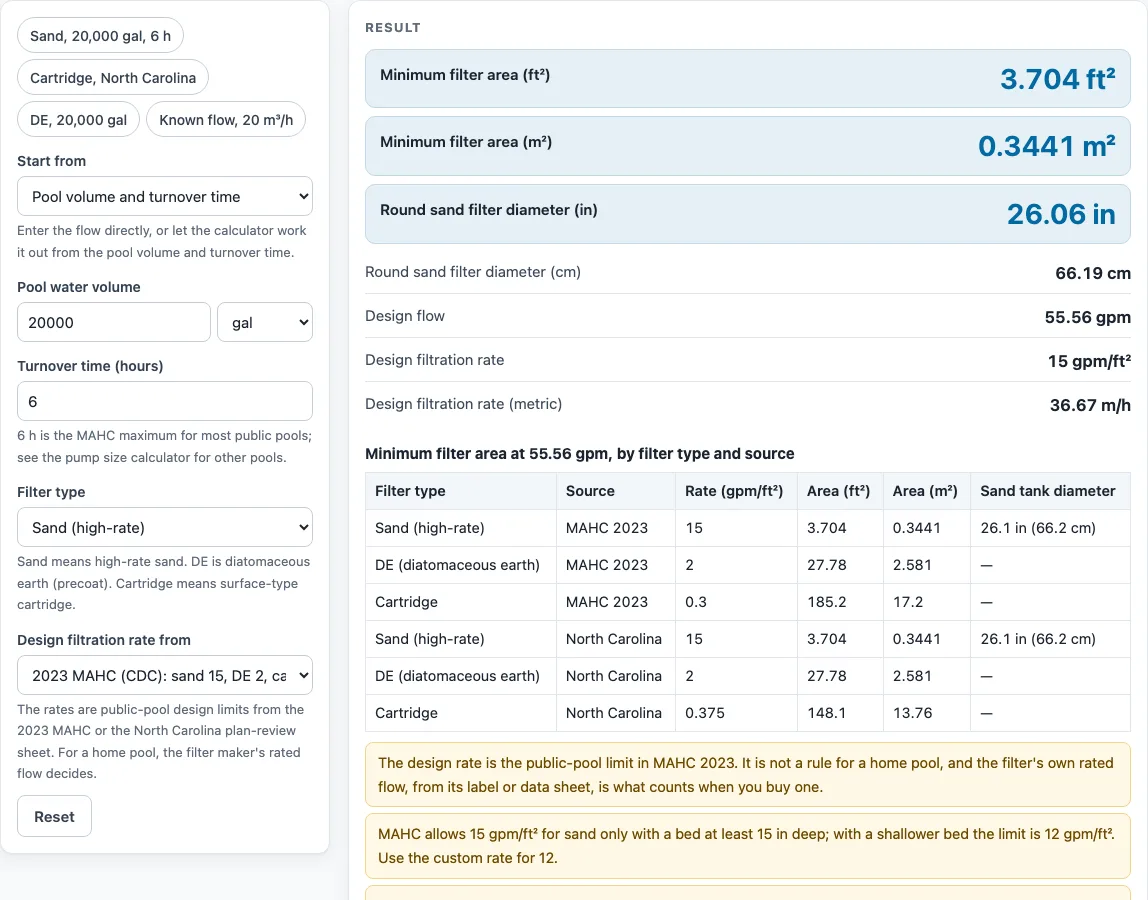
How to use the Pool Filter Size Calculator
- Choose the filter type: high-rate sand, DE (diatomaceous earth, precoat) or surface-type cartridge.
- Under “Start from”, choose A known flow and type it in gpm, L/min or m³/h, or choose Pool volume and turnover time, and the tool works out flow as volume ÷ turnover time.
- Set the unit for each quantity using its own unit menu. You can mix metric and US customary units, because the tool converts them before it calculates.
- Choose the rate source: MAHC 2023 or North Carolina. A table shows the minimum area for all three filter types under both sources. You can also type a custom rate.
- Read the minimum area in ft² and m². For a sand filter, also read the tank diameter in inches and centimetres.
- Open “How it was calculated” under the result to see the formula, the values used and the answer with units.
- Pick a filter whose listed area is at least the minimum shown.
Preset buttons above the form load typical cases. “More options” holds the less common inputs, and “Reset” restores the starting example.
“Copy result” copies the result lines with a link. “Copy link” copies the page address, which stores every input in the ?s= part of the URL, so the same calculation reopens later or can be sent to a colleague. “Print / save as PDF” prints a one-page record with the inputs, the results, the calculation steps and the date.
How do I size a pool filter?
Size a pool filter by dividing the design flow by the design filtration rate. The result is the minimum filter area, and the filter you choose must have at least that area.
Flow comes from either a known figure or from volume ÷ turnover time. For example, 20,000 gal turned over every 6 h needs 3,333 gal per hour, which is 55.56 gpm.
What size sand filter do I need for my pool?
Divide the flow by the sand filtration rate to get the minimum area, then find the round tank diameter for that area. The diameter comes from D = √(4 × area ÷ π). At 55.56 gpm and 15 gpm/ft², the minimum area is 3.704 ft² (0.3441 m²). A round tank with that area is about 26.06 in (66.19 cm) across.
How many square feet of cartridge filter do I need?
Divide the flow by the cartridge rate. The MAHC 2023 rate is 0.30 gpm/ft², and the North Carolina rate is 0.375 gpm/ft². For 55.56 gpm at 0.30 gpm/ft², you need 185.2 ft² (17.2 m²). At 0.375 gpm/ft², the same flow needs about 148.2 ft². Cartridges need far more area than sand for the same flow because their rate per square foot is much lower.
What is the filtration rate for a sand filter?
The filtration rate is the flow per square foot of filter area that the design rules allow. The MAHC 2023 sets at most 15 gpm/ft² for high-rate sand when the bed is at least 15 in deep, and 12 gpm/ft² for a shallower bed. North Carolina’s public pool plan-review sheet (February 2024) lists 15 to 20 gpm/ft². This page uses 15 for sand under both sources. In metric units, 15 gpm/ft² is about 36.7 m/h.
These are limits for public pools. No public residential limit was found.
What flow rate is used for DE filters?
DE filters use 2 gpm/ft² under the MAHC 2023. The North Carolina sheet lists 2 gpm/ft² without slurry and 2.5 gpm/ft² with slurry, and this page uses 2 for both sources. In metric units, 2 gpm/ft² is about 4.9 m/h. At 55.56 gpm, a DE filter needs 27.78 ft² (2.581 m²).
Sources
Checked October 2026:
- Design filtration rates (sand 15 gpm/ft² with a bed of at least 15 in, 12 below; DE 2, 2.5 with continuous slurry; cartridge 0.30): CDC 2023 Model Aquatic Health Code
- North Carolina public pool plan review sheet (February 2024): sand 15–20, DE 2 / 2.5, cartridge 0.375 gpm/ft² (PDF)
- Area = flow ÷ rate; tank diameter D = √(4A/π); 1 US gal = 3.785411784 L (NIST)
For estimation; verify critical designs against the applicable standard.
Worked examples
| Input | Result |
|---|---|
| 20000 gal, 6 h, Sand (high-rate), rate from MAHC 2023 | At least 3.704 ft² (0.3441 m²); sand tank about 26.1 in across |
| 75 gpm, Cartridge, rate from North Carolina | At least 200 ft² (18.58 m²) |
| 20 m³/h, DE (diatomaceous earth), rate from MAHC 2023 | At least 44.03 ft² (4.09 m²) |
| 60 m³, 4 h, Sand (high-rate), rate from North Carolina | At least 4.403 ft² (0.409 m²); sand tank about 28.4 in across |
Calculated by the tool above with these values.
Frequently asked questions
Can I use the results in commercial projects or client reports?
Yes. Results may be used in commercial work, including quotes, design notes, reports and client projects, without attribution. The page also says “For estimation; verify critical designs against the applicable standard,” so check critical designs against the standard that applies to your project.
Is the calculator free, and is anything I type uploaded?
The calculator is free, and there is no account or sign-up. Everything is calculated in your browser, and nothing you type is uploaded.
Can I print or share a calculation?
Yes. “Print / save as PDF” produces a one-page record with the inputs, the results, the calculation steps and the date. “Copy link” copies a page address that stores every input, so the same calculation reopens later or can be sent to a colleague.
Why does a cartridge filter need so much more area than sand?
The allowed rate per square foot is far lower for cartridges (0.30 or 0.375 gpm/ft²) than for high-rate sand (15 gpm/ft²), so the same flow needs about 40 to 50 times the area.
What filtration rate should I use for a home pool?
No public residential limit was found, so the rates on this page are public-pool design limits. For a home pool, the filter maker’s rated flow decides the filter you should use.
Related tools
- Pool pump size calculator: use it to match a pump’s flow to the filter you are sizing.
- Pool volume calculator: use it to find the pool volume you need to work out flow from turnover time.
- Pool chlorine calculator: use it to estimate chlorine doses for the water in your pool.
- Pool heater calculator: use it to estimate heater sizing for your pool.
- Pool chemical calculator: use it to estimate chemical amounts for pool water balance.
- All water treatment calculators: use it to browse every calculator on the site.