Pool Evaporation Calculator
Enter the pool size, water and air temperatures, humidity and air speed to estimate the water and heat lost to evaporation.
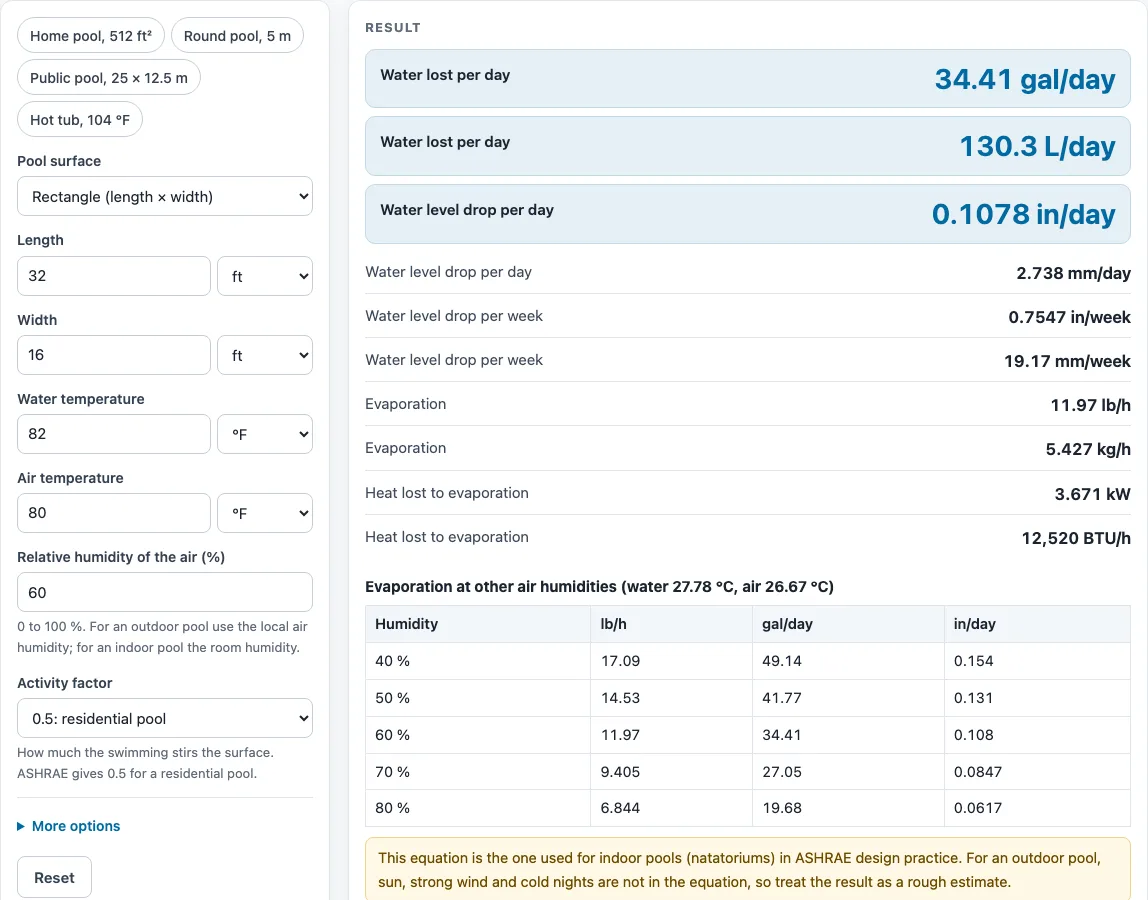
The pool evaporation calculator estimates how much water and heat a pool loses to evaporation. It reports the loss in lb/h and kg/h, the water lost per day in gallons and litres, the daily and weekly drop in water level, and the heat lost in BTU/h and kW.
The calculation uses the Carrier equation, the method used in ASHRAE natatorium design for indoor pools. It runs in your browser, it is free, and it needs no sign-up. Enter your pool size, water and air temperatures, humidity, air speed and activity level, and the result updates as you type. For an outdoor pool, treat the figure as a rough estimate, because sun, wind and cool nights are not part of the equation.
How to use the Pool evaporation calculator
- Under “Pool surface”, choose a rectangle (length and width), a round pool (diameter) or a known area, then enter the size and pick the unit for each value: ft, m, ft² or m².
- Enter the water temperature and choose °F or °C.
- Enter the air temperature and choose °F or °C.
- Enter the relative humidity of the air, in percent.
- Enter the air speed over the water and choose ft/min, m/s or mph. The method’s stated basis is 10 to 30 ft/min. Outside that range, a warning says the result is an extrapolation.
- Choose the activity factor: 0.5 for residential, 0.65 for a fitness club, therapy or elderly swim, 0.8 for a hotel, or 1.0 for a public pool, swim meet or whirlpool (ASHRAE values as quoted in public engineering references). You can also enter your own value.
- Read the results: evaporation in lb/h and kg/h, water lost per day in gallons and litres, level drop per day and per week, and heat lost in BTU/h and kW.
- Open “How it was calculated” under the result to see the formula, the values substituted and the answer with units.
Preset buttons above the form load typical cases, and “More options” holds the less common inputs. The table shows evaporation at air humidities from 40 to 80 % with your other inputs. “Reset” restores the starting example.
How much water does a pool lose to evaporation?
A pool loses water at a rate per square foot of surface, multiplied by the surface area and the activity factor. The rate comes from the Carrier equation:
W = (95 + 0.425 v)(pw − pa) ÷ Y
W is the evaporation rate in lb/h per ft² of water surface. v is the air speed at the water in ft/min. Y is the latent heat in BTU/lb, and the result is divided by it. pw is the saturation vapor pressure at the water temperature. pa is the relative humidity times the saturation pressure at the air temperature. Both pressures are in inches of mercury. Vapor pressure comes from the Buck equation, and latent heat comes from a straight line through NIST water property data. Both match NIST values within 0.05 %.
Total evaporation is W × surface area × activity factor. For a 32 × 16 ft pool (512 ft²) with water at 82 °F, air at 80 °F and 60 % humidity, 15 ft/min air speed and an activity factor of 0.5, the result is 11.97 lb/h. That equals 34.4 gallons per day. One litre per square metre of surface is one millimetre of depth, so the volume lost converts directly into a level drop.
What does the activity factor change?
The activity factor scales the result for how the pool is used. Undisturbed water evaporates less than water with swimmers in it. In one measurement study (OSTI 653225), undisturbed pools evaporated at 74 % of the unmodified equation, and pools in use evaporated more than quiet ones. A factor of 1.0 leaves the equation unscaled.
The equation is written for indoor pools. Pool covers, splash-out and leaks are not included, so add those separately if they matter for your figures.
Sources
Checked October 2026:
- Carrier equation W = (95 + 0.425 v)(pw − pa)/Y and the 74 % measurement on undisturbed pools: Smith, Löf and Jones, “Rates of evaporation from swimming pools in active use” (OSTI 653225)
- Activity factors (ASHRAE natatorium table, as quoted): EnergyPlus engineering reference, indoor swimming pool and PoolPak humidity control calculations
- Saturation vapor pressure: Buck equation (1996), within 0.05 % of NIST; latent heat fitted to the NIST Chemistry WebBook water data
For estimation; verify critical designs against the applicable standard.
Worked examples
| Input | Result |
|---|---|
| 512 ft², water 82 °F, air 80 °F at 60 % | 34.4 gal/day (130 L/day), 0.108 in/day (2.74 mm/day), 3.67 kW |
| 211.3 ft², water 28 °C, air 24 °C at 50 % | 20.3 gal/day (76.8 L/day), 0.154 in/day (3.91 mm/day), 2.16 kW |
| 3,364 ft², water 28 °C, air 30 °C at 55 % | 408 gal/day (1,540 L/day), 0.195 in/day (4.94 mm/day), 43.5 kW |
| 800 ft², water 80 °F, air 78 °F at 50 % | 79.5 gal/day (301 L/day), 0.159 in/day (4.05 mm/day), 8.48 kW |
Calculated by the tool above with these values.
Frequently asked questions
Can I use the results in commercial projects or client reports?
Yes. You can use them in quotes, design notes, reports and client projects without attribution. For critical designs, check against the applicable standard, as the page note advises.
Is the calculator free, and is anything I type uploaded?
It is free. Nothing you type is uploaded, because all the calculation happens in your browser, and no account is needed.
Can I print or share a calculation?
Yes. Print / save as PDF gives you a one-page record with inputs, results, steps and the date. Copy link keeps every input in the page address, so others can open the same figures.
How much does a pool level drop per day?
It depends on the surface area and the evaporation rate. The 32 × 16 ft example with 82 °F water, 80 °F air and 60 % humidity drops 0.108 in (2.74 mm) per day, or 0.755 in per week.
Does a pool cover change the result?
The calculator does not model a cover. The equation assumes open water, so a covered pool loses less than the result shows.
Why is my evaporation result zero?
The air’s vapor pressure is at or above the water’s, so there is no net evaporation. Warm, humid air above the water temperature can cause this. Check the values in “How it was calculated” to see which input is responsible.
Related tools
- Pool volume calculator: use it to find the water volume of your pool before you plan refilling or treatment.
- Pool heater calculator: use it to size a heater for the heat your pool loses.
- Pool pump size calculator: use it to choose a pump that suits your pool’s flow needs.
- Rainwater harvesting calculator: use it to estimate how much rain you could collect to top up the pool.
- Water usage calculator: use it to see how refilling for lost water fits into your household or site total.
- All water treatment calculators: use it to browse every calculator on the site.