Aquarium Volume Calculator
Pick the fish tank shape and enter its outside dimensions to get the gallons and litres of water and the weight it puts on the stand.
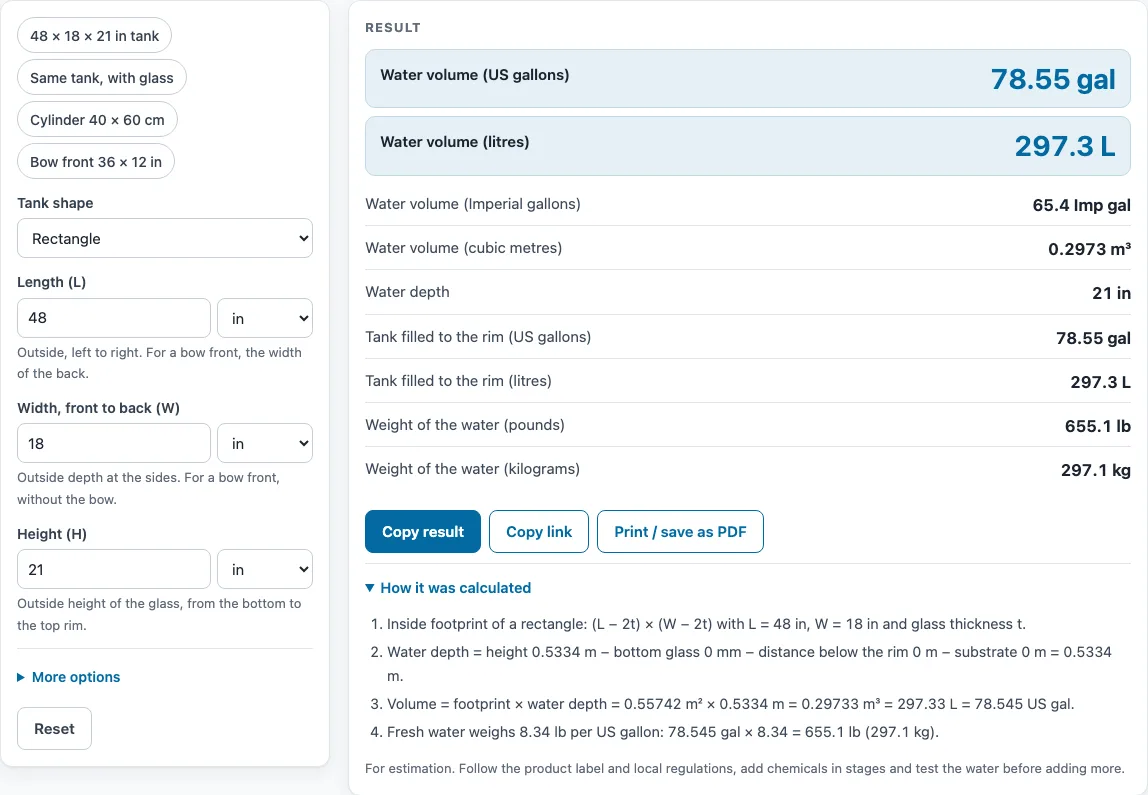
How to use the Aquarium Volume Calculator
- Click a preset button above the form if your tank matches a typical case, such as the 48 × 18 × 21 in rectangle or the 40 × 60 cm cylinder. Otherwise, start from the default example.
- Under Tank shape, choose rectangle, cube, cylinder, half cylinder, bow front, hexagon or corner tank.
- Enter the measurements for that shape. A rectangle needs length, width and height. A cylinder needs diameter and height. For a half cylinder, the diameter is the width of the flat back.
- Set the unit for each measurement using its own unit menu. You can use in, cm, ft, m or mm, and you can mix them.
- Open More options to add glass thickness, the distance from the rim down to the water level, and the substrate depth. All three start at zero.
- Read the result. It updates as you type. Open “How it was calculated” under the result to see the formula, the values substituted and the answer with units.
Once the result is right, use Copy result to copy the result lines with a link, or Copy link to copy the page address with your inputs. Print / save as PDF creates a one-page record. Reset restores the starting example.
How do you determine aquarium gallons?
To determine aquarium gallons, work out the volume in cubic inches and divide by 231, because one US gallon is 231 cubic inches. For a rectangular tank, multiply length by width by height. A 48 × 18 × 21 in tank holds 18,144 in³, and 18,144 ÷ 231 = 78.55 US gallons.
Glass and water level change that figure. Water depth equals the tank height minus the bottom glass, minus the distance from the rim down to the water, minus the substrate depth. Glass thickness is taken off every wall and off the bottom, so a rectangle uses (L − 2t) × (W − 2t) with height H − t. Substrate is treated as solid, which slightly underestimates the water, because gaps in gravel and sand also hold water.
Water weight follows from the volume. Fresh water is taken as 8.34 lb per US gallon, so 78.55 gallons weighs about 655 lb. Salt water uses a specific gravity of 1.025, which gives 8.34 × 1.025 = 8.55 lb per gallon.
How do you calculate gallons in an aquarium by shape?
To calculate gallons in an aquarium by shape, find the area of the water’s footprint, multiply it by the water depth, then convert to gallons. For a cylinder, the footprint is π × (D ÷ 2)². A cylinder 40 cm across with water 55 cm deep holds π × 20² × 55 = 69,115 cm³, or 69.12 litres, which is 18.26 US gallons.
A hexagon uses a footprint of (3√3 ÷ 2) × s², where s is the length of one side. A hexagon with 10 in sides and 20 in height has a footprint of about 259.8 in², giving 5,196 in³, or 22.49 gallons.
The bow-front volume is an approximation. The front is modelled as a circular arc through the two front corners, bulging out by the bow depth. Real bow-front glass may not be a perfect arc, so a warning appears with the result.
Tank labels such as “55 gallon” are nominal and often differ from the exact volume. The calculated figure is the better one to use for dosing, heater and conditioner calculations.
Sources
Checked October 2026:
- Standard mensuration formulas for boxes, cylinders and circular segments; fresh water 8.34 lb per US gallon; marine water at specific gravity 1.025
- NIST SP 811 for gallon and litre conversions
For estimation; verify critical designs against the applicable standard.
Worked examples
| Input | Result |
|---|---|
| rectangular tank, L = 48 in, W = 18 in, H = 21 in | 78.55 gal (297.3 L), water weight 655 lb |
| rectangular tank, L = 48 in, W = 18 in, H = 21 in, glass 6 mm, water 1.5 in below the rim, substrate 2 in | 62.26 gal (235.7 L), water weight 532 lb |
| cylinder tank, D = 40 cm, H = 60 cm, water 5 cm below the rim | 18.26 gal (69.12 L), water weight 152 lb |
| bow-front tank, L = 36 in, W = 12 in, bow = 3 in, H = 16 in | 34.94 gal (132.2 L), water weight 291 lb |
| hexagon tank, s = 10 in, H = 20 in | 22.49 gal (85.15 L), water weight 188 lb |
Calculated by the tool above with these values.
Frequently asked questions
Can I use the results in commercial projects or client reports?
Yes. Results may be used in commercial work, including quotes, design notes, reports and client projects, without attribution. The results are estimates.
Is the calculator free, and is anything I type uploaded?
The calculator is free. Everything is calculated in your browser, nothing you type is uploaded, and there is no account or sign-up.
Can I print or share a calculation?
Yes. Print / save as PDF creates a one-page record with your inputs, the results, the calculation steps and the date. Copy link stores every input in the ?s= part of the page address, so the same calculation reopens later or can be sent to a colleague.
Why does my result differ from the size on the tank label?
Labels such as 55 or 75 gallons are nominal, so the exact volume often differs. Use the calculated figure for dosing. Follow the product label, add chemicals in stages and test the water before adding more.
Can I mix metric and US units?
Yes. Each quantity has its own unit menu, so you can enter one measurement in cm and another in inches. The tool converts them before it calculates.
What do the error messages mean?
An error appears if the glass is too thick for the tank, if the water level and glass leave no water depth, or if the substrate is as deep as the water. Adjust the glass thickness, water level or substrate depth to clear the error.
Related tools
- Pool Volume Calculator: Use it to find the water volume of a swimming pool before planning treatment.
- Tank Size Calculator: Use it to compare tank sizes and volumes when you are choosing a new tank.
- Chlorine Dosage Calculator: Use it to estimate how much chlorine a pool or tank volume needs.
- Langelier Saturation Index Calculator (LSI): Use it to check whether water is likely to be corrosive or scale-forming.
- Pool Chlorine Calculator: Use it to work out chlorine amounts for a pool.
- Pool Salt Calculator: Use it to estimate the salt needed to reach a target salinity in a pool.
- Rainwater Harvesting Calculator: Use it to estimate how much rainwater a roof can collect and store.
- All water treatment calculators: Use it to browse every calculator on the site.