Tank Size Calculator (Tank Volume Calculator)
Pick the tank shape and enter its dimensions to get the capacity, or add the liquid depth to see how many gallons or litres are in it now.
Popular tools
- Pool Salt CalculatorEnter the pool volume, the current salt reading and the target level to get the pounds or kilograms of salt and the number of bags to add.
- Septic Tank Size CalculatorEnter the number of bedrooms or the daily flow to get the septic tank size in gallons and litres, with a chart for 1 to 8 bedrooms.
- Pool Chemical CalculatorChoose alkalinity, stabilizer, calcium or pH, enter the water volume and your readings, and get the amount of chemical to add.
The tank size calculator finds the total capacity of a tank from its shape and dimensions. If you also enter a liquid depth, it shows how much liquid is inside. It covers eight shapes, including horizontal and vertical cylinders, rectangular boxes, capsules, cone-bottom tanks, oval tanks and spheres, and reports results in US gallons, litres, cubic metres, cubic feet, Imperial gallons and barrels.
The calculator runs in your browser. It is free, and there is no account or sign-up. It is the quick way of figuring gallons in a tank, a tank gallon calc that also works in litres. Results update as you type, so you can figure out gallons in a tank, compare tank sizes or check how full a tank is at a given level.
How to use the Tank Size Calculator
- Pick a shape. Under Tank shape, choose one of the eight shapes. Or click a preset above the form: horizontal 4 × 10 ft, vertical 10 × 12 ft, box 6 × 3 × 4 ft, or a 6 ft sphere half full.
- Enter the dimensions for that shape. The inputs change with the shape, for example diameter and length for a horizontal cylinder, or straight-side height and cone height for a cone-bottom tank.
- Set the unit for each dimension. Each dimension has its own selector (ft, in, m, cm, mm or yd), so you can mix metric and US units.
- Enter inside dimensions. The calculator uses the numbers exactly as typed.
- Enter a liquid depth if you need one. It is measured from the lowest inside point, like a dipstick reading. Leave it empty to get the capacity only.
- Read the result. Open “How it was calculated” under the result to see the formula, the values substituted and the answer with units.
- Check the level chart. It shows the volume at every 10 % of tank height by default. You can switch it to one row per inch (or per centimetre for metric dimensions), up to 40 rows, or turn it off.
Copy link keeps every input in the page address, and Print / save as PDF gives a dated record.
How do you calculate tank capacity?
Total capacity is the volume of the inside of the tank, found from its shape and inside dimensions. Identify the shape, convert every dimension to the same unit, then apply that shape’s volume formula. A box or vertical cylinder needs one multiplication, while curved shapes need a longer formula.
For a box, multiply length, width and height. For a vertical cylinder, take the circle area from the diameter and multiply by the height. A sphere of diameter 6 ft holds about 113 ft³, which is 846 US gal. A capsule is a cylinder of length L − D plus two hemispherical ends, and a cone-bottom tank adds the cone volume inside the lower section.
How do you calculate the volume of a water tank?
Calculate the water volume as the area of the cross-section multiplied by the length of the liquid, or by the depth for an upright tank. For a vertical cylinder or a rectangular tank, the volume grows in a straight line with depth, so V = π × (D ÷ 2)² × h or V = L × W × h.
A horizontal cylinder is different. Its cross-section is curved, so the volume is found from the circular segment area: V = L × [r² × arccos((r − h) ÷ r) − (r − h) × √(2rh − h²)], where r = D ÷ 2 and h is the liquid depth. A horizontal oval tank uses the same formula stretched by W ÷ H.
What is the formula for tank volume?
There is no single formula for every tank. Each shape has its own, and the calculator uses the one that matches the shape you choose. Sphere: V = π h² (3r − h) ÷ 3 for a partly filled sphere of radius r. Box: V = L × W × H. Vertical cylinder: V = π × (D ÷ 2)² × H.
Units are converted before the calculation. The factors used are 1 US gal = 3.785411784 L, 1 Imp gal = 4.54609 L, 1 ft³ = 28.316846592 L, and 1 bbl = 42 US gal. For example, a 6 × 3 × 4 ft box has 72 ft³, which is 538.6 US gal.
Why is volume not proportional to depth in a horizontal tank?
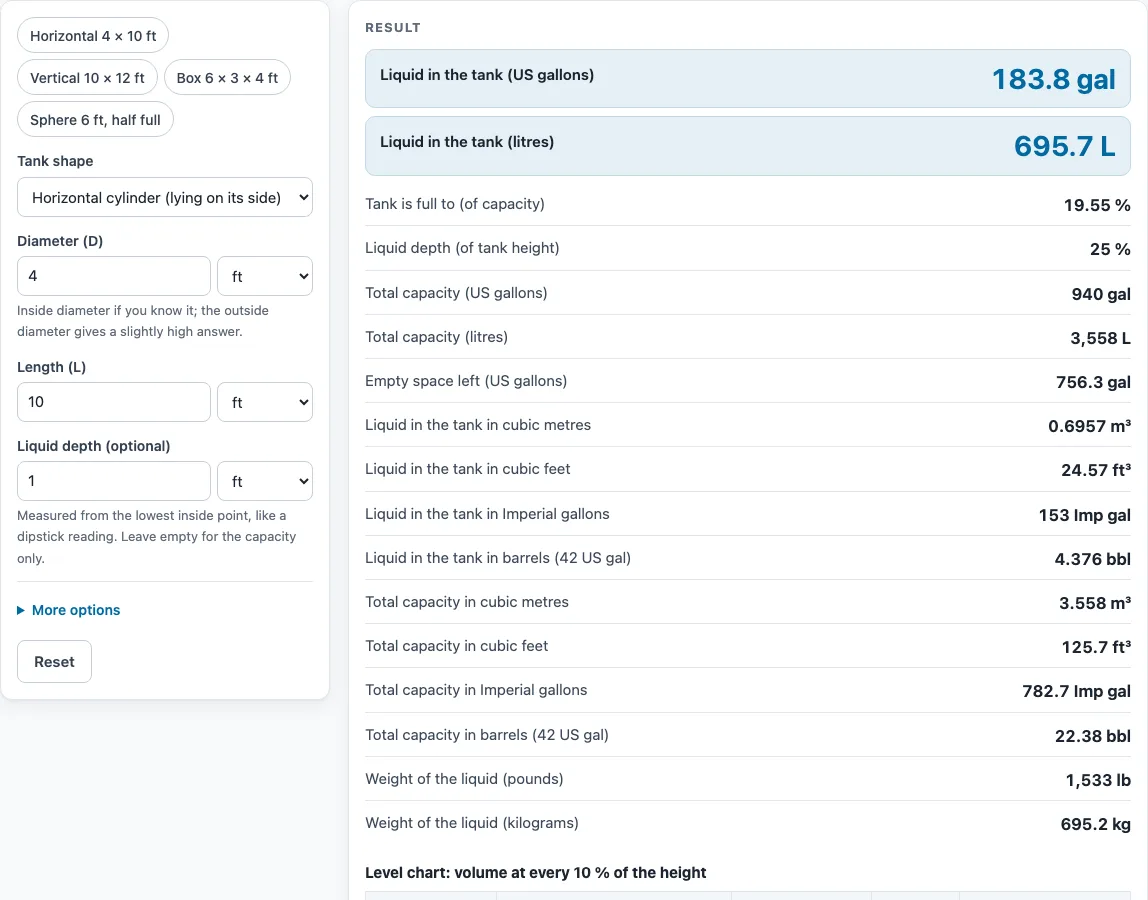
In a horizontal cylinder, the width of the liquid surface changes with depth. The bottom of the tank is narrow and the middle is wide, so each extra inch adds a different amount of volume. In the example D = 4 ft, L = 10 ft, a 1 ft depth (25 % of the diameter) holds 183.78 gal, only 19.55 % of the 940.03 gal capacity.
The calculator treats the depth as a dipstick reading from the lowest inside point. Geometry assumes flat ends, no fittings, no baffles and no sloped bottoms, except the cone-bottom option.
Sources
Checked October 2026:
- NIST SP 811 for gallon, litre and pound conversions (1 US gal = 3.785411784 L)
- Circular segment, spherical cap, cone and frustum volume formulas from standard mensuration texts (for example the CRC Standard Mathematical Tables)
- Diesel and gasoline densities are typical ranges only (see Engineering ToolBox, fuel densities); use Custom with your supplier’s data sheet
For estimation; verify critical designs against the applicable standard.
Worked examples
| Input | Result |
|---|---|
| horizontal cylinder, D = 4 ft, L = 10 ft, liquid depth 1 ft | 183.8 gal (695.7 L) = 19.6 % of the 940 gal capacity |
| vertical cylinder, D = 10 ft, H = 12 ft, liquid depth 8 ft | 4,700 gal (17,790 L) = 66.7 % of the 7,050 gal capacity |
| rectangular tank, L = 6 ft, W = 3 ft, H = 4 ft, liquid depth 30 in | 336.6 gal (1,274 L) = 62.5 % of the 538.6 gal capacity |
| oval horizontal tank, W = 120 cm, H = 80 cm, L = 3 m, liquid depth 40 cm | 298.8 gal (1,131 L) = 50 % of the 597.5 gal capacity |
| sphere, D = 6 ft, liquid depth 3 ft | 423 gal (1,601 L) = 50 % of the 846 gal capacity |
Calculated by the tool above with these values.
Frequently asked questions
Can I use the results in commercial projects or client reports?
Yes. Results may be used in commercial work, including quotes, design notes, reports and client projects, without attribution. The page notes that results are for estimation, so check critical designs against the applicable standard.
Is the calculator free, and is anything I type uploaded?
The calculator is free. Everything is calculated in your browser, and nothing you type is uploaded. There is no account or sign-up.
Can I print or share a calculation?
Yes. “Print / save as PDF” prints a one-page record with the inputs, results, calculation steps and date. “Copy link” copies a page address that stores every input, so the calculation reopens with the same values.
What happens if the liquid depth is higher than the tank height?
A warning appears, and the tank is treated as full. Check the depth and tank height if you see this warning unexpectedly.
Should I use inside or outside dimensions?
Use inside dimensions, because the calculator uses the numbers exactly as typed. Outside measurements include the wall thickness and will overstate the usable capacity.
Can the calculator work out the weight of the liquid?
Yes. The weight is calculated from the volume and a density: water at 8.34 lb/gal, or diesel or gasoline at typical densities, or a custom value. Diesel and gasoline densities vary with grade and temperature, so check the supplier’s data sheet.
What does the warning about a capsule mean?
A capsule’s overall length or height must be at least its diameter. If it is smaller, the calculator rejects the input, so correct the overall length or height.
Related tools
- Aquarium Volume Calculator: use it to find the water volume of an aquarium before adding treatments.
- Chlorine Dosage Calculator: use it to work out how much chlorine a volume of water needs.
- Langelier Saturation Index Calculator (LSI): use it to estimate whether water is likely to scale or corrode.
- Pool Chlorine Calculator: use it to estimate chlorine needed for a swimming pool.
- Pool Salt Calculator: use it to estimate salt needed for a salt chlorine pool.
- Pool Volume Calculator: use it to find the water volume of a pool before dosing.
- Rainwater Harvesting Calculator: use it to estimate how much rainwater a roof can collect.
- All water treatment calculators: use this page to browse every calculator on the site.